
Professional business guide
Dog Wedding Chaperone Insurance and Business Requirements
A practical framework for investigating insurance, registrations, licences and professional requirements before you accept paid bookings.
Wedding work can combine pet care, transport, property access, public venues, long hours and multiple suppliers. The task is to describe that real service accurately, then verify what applies.
Published 15 August 2026 · By Dog Wedding Kit

A policy designed for one narrow pet-care activity may not automatically respond to every element of a wedding service. That is a reason for a precise conversation, not for alarm.
Start with what you actually do: when responsibility begins and ends, where the dog goes, who handles the dog, whose vehicle is used, whether you enter property and whether care continues overnight. Match package descriptions, client paperwork and day-to-day practice to the activities disclosed to the insurer.
This guide owns detailed insurance and compliance preparation. For the wider sequence of choosing a business model, pricing and launching, use the startup guide.
The free startup checklist gives you a printable place to record which requirements, cover questions and renewal triggers still need verification.
This international guide is not legal, insurance, tax, financial or veterinary advice. Requirements and policy wording change by country, state or region, council, insurer, business structure and activity. Use the process here to prepare questions, then confirm them with relevant authorities and qualified local advisers.
01 · The starting point
There is no single global dog wedding chaperone policy
Dog wedding chaperone is a service description, not a universal insurance or licensing class. One provider may attend a venue for two hours; another may collect a dog from a home, drive it, handle it around guests, return keys and provide an overnight stay. Those are materially different activity sets.
Names also vary. UK materials commonly use public liability; US materials often use general liability. Pet-specific sections may be described as care, custody and control, animal bailee or pet protection. Similar labels do not guarantee identical cover. The schedule, endorsements, definitions and exclusions attached to the policy are what matter.
02 · Describe the service
Give the insurer the real activity list
A broker can only assess the service described. Use plain operational language rather than relying on a job title, and do not omit an activity merely because it may affect eligibility or premium.
- Dog walking and pet sitting before or after the event
- Attendance at wedding venues and contact with guests or suppliers
- Dog collection, return and travel in your own, a client's or a hired vehicle
- Entry to client homes, hotels or accommodation
- Key holding, access codes and alarm instructions
- How many dogs may be handled together
- Employees, contractors, volunteers or substitute handlers
- Care after the wedding and any overnight stay
- Dogs staying at your own premises
- Ceremony and photography support
- Equipment supplied and the geographic service area
Give the insurer your current package descriptions too. A package that promises collection, transport and overnight care should not sit beside an application that describes only dog walking.
03 · Liability concepts
Public or general liability addresses third-party claims
At a high level, this class of insurance commonly relates to allegations that business activity caused injury to another person or damage to third-party property, subject to the contract. A guest tripping over equipment and damage at a venue illustrate the type of question to raise; they do not predict whether a claim would be covered.
Do not treat the word “liability” as proof that the client dog, property entrusted to you, your own injury, a vehicle journey or a worker is covered. Each may sit elsewhere in a policy or be excluded.
Care, custody and control deserves a direct answer
Standard liability wording may exclude or restrict property in the insured's care, custody or control. Pet-care policies may add specific cover for clients' pets and sometimes their property while entrusted to the business. Pet Sitters International therefore tells US pet-care businesses to look for pet-specific general liability that includes care, custody and control.
Ask when a dog enters and leaves your “care” under the policy, whether accidental injury, escape or loss is treated differently, whose property is included and which conditions apply. Do not infer the answer from a badge on an insurer's marketing page.
Animal bailee and pet protection terminology
Some markets or insurers may use animal bailee, pet protection or another heading for animal-related cover. These terms are not safely interchangeable without reading their definitions. Ask the adviser to show where the policy responds to the dog itself and where the relevant exclusions, sublimits and deductibles or excesses appear.
Professional indemnity or errors and omissions
This type of cover may concern allegations arising from professional services, advice or mistakes. Whether a chaperone's work fits the insurer's definition, or whether the exposure is already handled elsewhere, depends on the product and service. Ask rather than automatically buying or dismissing it.
04 · Coverage conversation map
Questions to discuss with your insurance broker
These are activities and risks to disclose, not guaranteed product names or a recommendation to buy every available cover.
Dogs in your care
Ask how the policy treats injury, loss or damage involving a client dog while responsibility has transferred to you.
Third parties
Describe guest contact, public spaces and the potential for injury or property damage away from your own premises.
Dog transport
Disclose collection, return, journey purpose, vehicle ownership, restraints and whether staff or contractors drive.
Homes and property
Explain client-home entry, accommodation collection, key holding, access codes and property left in your control.
People in the service
Identify employees, contractors, volunteers, substitutes and any additional wedding-day handlers.
Extended care
Describe overnight stays, boarding location, multiple dogs, longer hours and any change from event-only attendance.
Venues and events
Explain wedding attendance, supplier status, requested certificates, contract terms and geographic service area.
Business resilience
Ask separately about equipment, cyber/data risk, personal accident, income protection and interruption where relevant.
05 · Property access
Client homes, keys and allegations of dishonesty are separate questions
Home collection can introduce risks involving lost keys, copied or exposed access codes, alarm activation, accidental property damage and disputed theft. Explain exactly who receives access and how keys are stored, labelled, transferred and returned.
Bonding or fidelity cover in some markets relates to dishonest acts or theft involving staff or service providers. It is not another name for liability insurance and is not universally required. Ask who qualifies as a covered person, and document access through the forms and paperwork process.
06 · Transport
Check the vehicle policy and the pet-business policy
Using a personal vehicle for paid dog transport can raise at least two different questions: is the vehicle insured for the relevant business use, and does the pet-care policy respond while the dog is in transit? Confirm both. Also describe who drives, vehicle ownership, collection locations, restraints or containment, journey distances and whether dogs from different households travel together.
Animal-welfare and commercial transport rules are jurisdiction-specific. Great Britain's official guidance, for example, distinguishes journeys connected with an economic activity and sets circumstances in which transporter authorisation or other documentation may apply. That example does not establish the rule in another country or decide whether a particular wedding journey is in scope.
Use an activity-change check before relying on existing cover
- 01
Does your current insurer know you offer wedding-related dog care?
- 02
Are you transporting client dogs in any vehicle?
- 03
Are you entering homes, accommodation or holding keys and codes?
- 04
Are you offering overnight care or boarding at your premises?
- 05
Are employees, contractors or additional handlers involved?
- 06
Are venues requesting certificates, wording or particular limits?
- 07
Has your package, territory, dog number or service scope changed?
Send the complete activity description to the insurer or broker, ask for the answer in writing and retain it with the current policy documents.
07 · Overnight and premises
Overnight care changes duration, location and responsibility
An overnight add-on may change policy eligibility, the declared business activity, the premises being used and applicable animal-care rules. Clarify whether the dog remains at the client's property, in wedding accommodation or at the provider's home. Check business cover, home or premises cover, client authority and local licensing separately.
A client's home is not the same as your home
England offers a clear illustration of the distinction: current GOV.UK home-boarding guidance covers commercial accommodation for dogs inside the provider's domestic home, while looking after a dog in its normal residence is outside that particular home-boarding activity. Day care at a separate facility has different guidance again. This is an England-specific example, not a worldwide exemption.
Adding home boarding should therefore trigger a fresh licensing, premises, landlord or mortgage, home-insurance, staffing and business-policy check. Do not describe it as a casual extension of venue care.
08 · People and capacity
Employees, contractors and additional handlers must be disclosed
Tell the insurer who may handle dogs, enter homes, drive or substitute for you. Check the policy definition of insured worker and whether employees, contractors, casual assistants, volunteers and labour supplied by another business are treated differently.
Employment and worker-injury arrangements vary. The UK government identifies employers' liability as a legal insurance issue for many employers. US federal and state requirements are divided across different systems, and the SBA directs businesses to their states. Australia operates jurisdictional workers' compensation schemes and Safe Work Australia directs employers to the relevant state or territory authority. Classification labels alone should not be used to avoid a local employment or insurance check.
Multiple dogs can change policy conditions and safe capacity
Ask whether there are conditions about the number of dogs, households, handlers, travel arrangements or group walks. Insurance approval does not determine safe handling capacity; assess the dogs, environment and staffing through the safety and welfare process. Do not copy another provider's maximum.
09 · Venues and media
A venue's evidence request is a contract question, not a global rule
A wedding venue may request a certificate of insurance, proof of public liability, a particular limit, policy dates, business details or—in some US contracts—additional-insured wording. Ask exactly what document and wording are required, who must issue it and when. Never alter a certificate yourself.
Venue requirements can be stricter than a legal minimum, but satisfying them does not prove that every business activity is covered or guarantee a preferred-supplier listing. Coordinate the relationship using the venue and planner guide.
Photography and media are not one permission
Routine service updates, assisting the wedding photographer and using images in business marketing are different activities. Tell the insurer what you do, respect venue and photographer arrangements, and obtain separate client permissions where appropriate. Guide 6 explains the documentation distinction.
10 · Other business risks
Ask what happens outside a liability claim
Equipment
Leads, crates, restraints, a business phone and other kit may need separate property or portable-equipment cover. Liability insurance should not be assumed to replace damaged or stolen equipment.
Personal accident and income
A sole operator may want to investigate what happens if illness or injury prevents work. This is a financial-planning question for an authorised adviser, not a universal insurance instruction.
Business interruption
Ask whether interruption cover is relevant, what insured event must occur and how the policy treats a mobile service with limited physical premises.
Cyber and data
Client addresses, contact details, access instructions, dog information and payment records create a modest but real information risk. Ask proportionate questions about devices, systems and response support.
11 · Policy reading
Read exclusions, conditions and definitions—not only the summary
A product page or certificate proves very little about a particular scenario. Review the full wording and schedule, then ask about any ambiguity. Record the version and renewal date.
- Excluded services or activities
- Animals, breeds or circumstances addressed by special terms
- Off-lead, escape or restraint conditions
- Vehicle use and dogs in transit
- Dog-number or group-handling conditions
- Employees, contractors and substitute handlers
- Overnight care, boarding and the insured premises
- Keys, access codes and clients' property
- Wedding, event or public-venue work
- Geographic or territorial limits
- Deductibles or excesses and any sublimits
- Notification, record and incident-reporting duties
Tell the insurer when the business changes
Revisit cover before adding wedding work, dog transport, overnight care, new people, a broader territory, more dogs or different premises. Renewal is also a useful point to compare the policy against current packages. Prior acceptance of a narrower service should not be treated as automatic approval of an expanded one.
12 · Business registration
Separate formation, tax, licences and insurance
These are connected but distinct checks. Depending on place and structure, a paid operator may need to investigate sole trader or sole proprietor registration, a company or entity filing, a trading name, tax registration, local permits and recurring filings. Insurance does not register the business, and registration does not confirm insurance or animal-care compliance.
The US Small Business Administration says registration depends on business structure and location, while licence and permit needs depend on activities and may arise at state, county or city level. Australia's business portal similarly directs operators to registrations and ABLIS for activity- and location-specific licences. Use the startup guide for the broader launch sequence.
Animal-care licences follow activities, not marketing labels
Ask separately about walking, pet sitting in the owner's home, day care, boarding at your home, boarding elsewhere and commercial animal transport. In England, current animal-activity guidance distinguishes home boarding, day care and care in the dog's normal residence. Other nations—and US or Australian states and local authorities—use different systems.
Tax obligations
Paid business income can create registration, reporting, record-keeping and payment duties that depend on jurisdiction, turnover, structure and employment arrangements. Keep accurate records and use the relevant tax authority or qualified adviser; this guide does not provide rates or individual tax advice.
Consumer, contract and privacy obligations
Service descriptions, prices, cancellations, refunds and advertising should be accurate and locally compliant. Contracts cannot simply remove statutory consumer rights. Personal information, veterinary contacts, access instructions and marketing consent also need deliberate collection, security, access and disposal. Do not invent a universal retention period. Build the records through the forms and paperwork guide and seek local review where needed.
13 · Broker checklist
What should you ask an insurance broker?
- Does the policy cover client dogs while they are physically in my care, custody or control?
- How are injury, loss, escape and damage involving a client dog treated?
- Does it cover the wedding and event activities I have described?
- Does it respond when I enter client homes or hold keys and access codes?
- Does it cover dogs in transit, and what must my motor insurer confirm?
- Is overnight care covered at each location I may use?
- Which employees, contractors, volunteers or additional handlers are insured?
- Are there limits or conditions relating to dog numbers, group handling or particular activities?
- Are any animal-related, off-lead, transport, geographic or premises exclusions relevant?
- How are client property and allegations of theft handled?
- Is my equipment covered, or does it require a separate section?
- What happens when I add a service, handler, territory or premises?
- What certificate or evidence can be issued to a wedding venue?
- Can contractual additional-insured wording be considered where requested?
- Which excess or deductible and sublimits apply to each relevant section?
- What records, timeframes and contacts apply after an incident or potential claim?
Documents to take to the conversation
- Plain-language service and package descriptions
- Locations and geographic service area
- When responsibility for the dog begins and ends
- Collection, return, vehicle and transport arrangements
- Expected dog numbers and handling model
- Employees, contractors and backup-handler structure
- Any overnight-care plan and premises used
- Wedding venue and guest-contact activities
- Home-entry, key and access-code procedures
- Safety, emergency and incident-recording procedures
- Existing policies, schedules and venue requests
Use representative processes, not private client files. If the answer changes what can be sold, revise the package before accepting the booking.
14 · Proof and incidents
Organise current evidence without publishing the whole policy
Keep the current policy schedule, wording, endorsements, renewal date, broker or insurer contacts and written activity confirmations together. Supply venues with the requested certificate or evidence through an appropriate channel. Avoid publishing full policy documents if they expose addresses, reference numbers or other sensitive information.
Incident records support accurate notification
Record what was observed, when and where it happened, actions taken, people contacted and the dog's handover. Keep photographs or communications only when relevant and lawful. Follow the notification method and timeframe in the policy and contact the insurer for claims guidance; do not use this article as a claims strategy. Guide 6 covers factual incident records in more detail.
15 · Common mistakes
Avoid assumptions that create a coverage gap
- Buying generic cover without describing pet-care and wedding activities
- Assuming public or general liability automatically covers the dog
- Not disclosing collection or transport
- Adding overnight care without a fresh premises, licence and policy check
- Treating a venue request as a universal legal requirement
- Forgetting employees, contractors or substitute handlers
- Copying another provider's cover limits or policy names
- Relying on an insurance marketing summary instead of the wording
- Ignoring exclusions, conditions, sublimits or geographic limits
- Letting a policy or venue certificate expire
- Selling package activities that were not declared
- Assuming a business registration answers an animal-care licensing question
16 · Before paid bookings
Professional-readiness checklist
Business setup
- Structure and name checked
- Registrations and tax questions checked
- Local permits identified
Insurance
- Full activities disclosed
- Wording and exclusions reviewed
- Renewal and evidence organised
Transport
- Vehicle insurer consulted
- Pet policy transit checked
- Local welfare rules checked
Dog care
- CCC response understood
- Capacity and handling limits set
- Overnight scope verified
Venue
- Evidence request confirmed
- Supplier terms understood
- Access and dog plan agreed
Client records
- Scope and handover clear
- Access permissions recorded
- Current dog information held
Emergency
- Contacts and authority current
- Incident process ready
- Insurer contact accessible
Data and privacy
- Collection is proportionate
- Access details secured
- Media consent separated
People
- Worker status checked locally
- Every handler disclosed
- Competence and roles recorded
17 · International examples
Three source trails show why local verification matters
These examples illustrate different systems; they are not complete country summaries and do not decide what applies to an individual operator.
Activity and employment distinctions
England's animal-activity guidance separates home boarding, day care and care in the dog's normal home. GOV.UK and Business.gov.uk also identify employer and business-vehicle insurance questions. Great Britain has separate animal-transport guidance for journeys connected with economic activity.
Pet-specific coverage terminology
Pet Sitters International's professional standards emphasise general liability specific to pet care with care, custody and control, and raise bonding, workers' compensation and commercial or non-owned auto questions. SBA guidance makes clear that registration and permits vary by structure, activity and location.
State, territory and local systems
Business.gov.au describes public liability, professional indemnity, vehicle and workers' compensation concepts, while directing operators to ABLIS for activity- and location-specific licences. Safe Work Australia points businesses to jurisdictional regulators because worker schemes differ.
18 · Dog Wedding Kit boundaries
Organisation can support compliance, but cannot create it
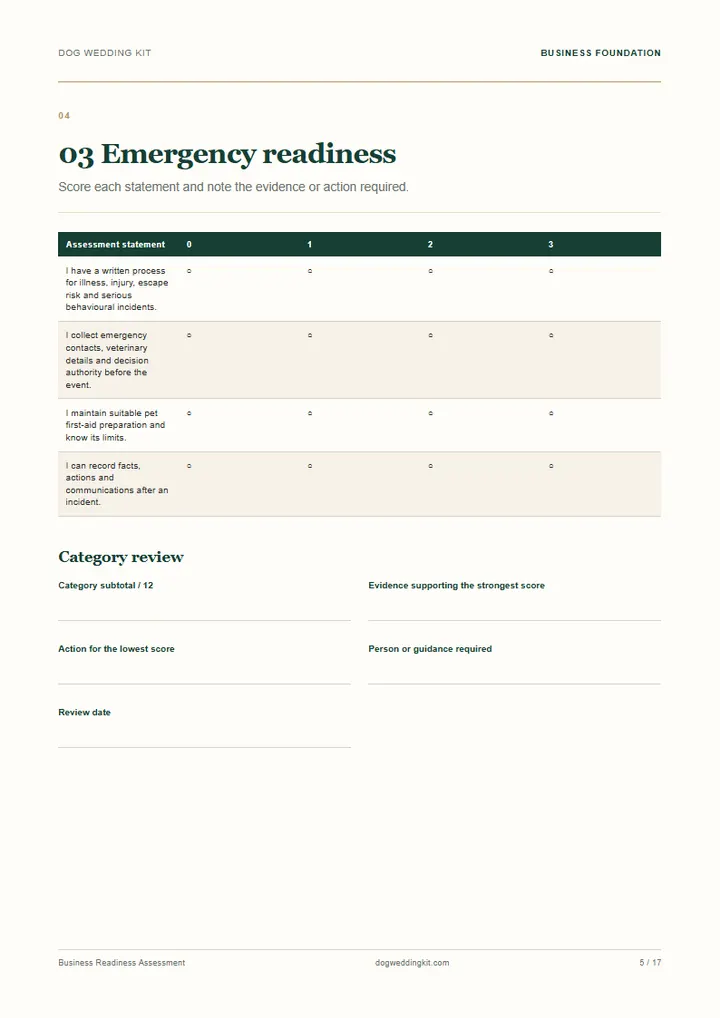
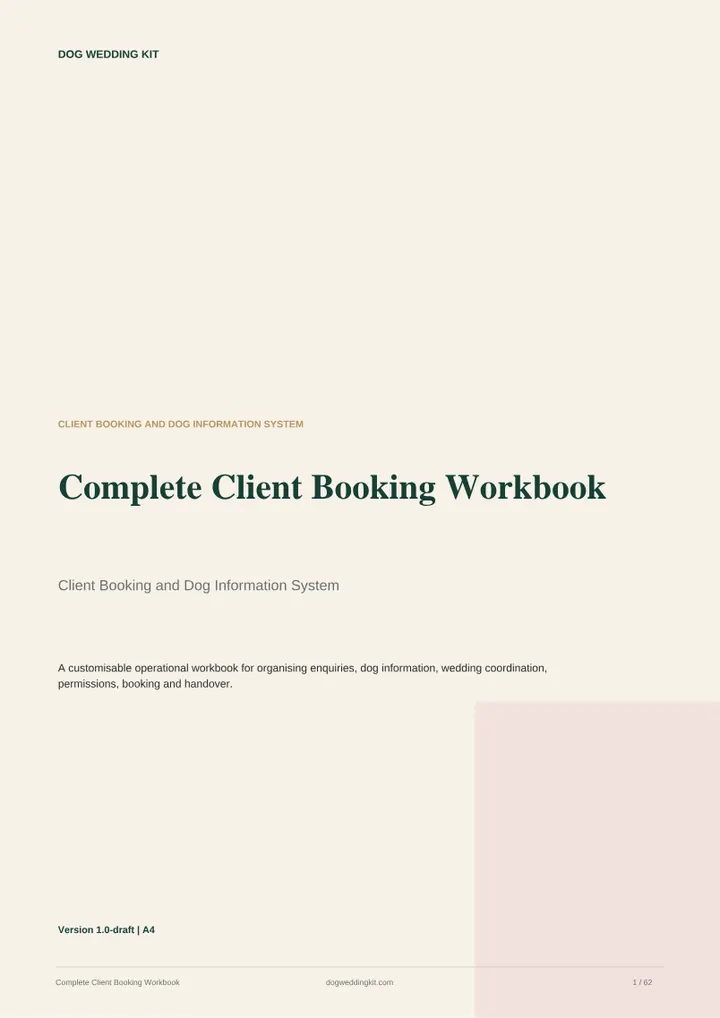
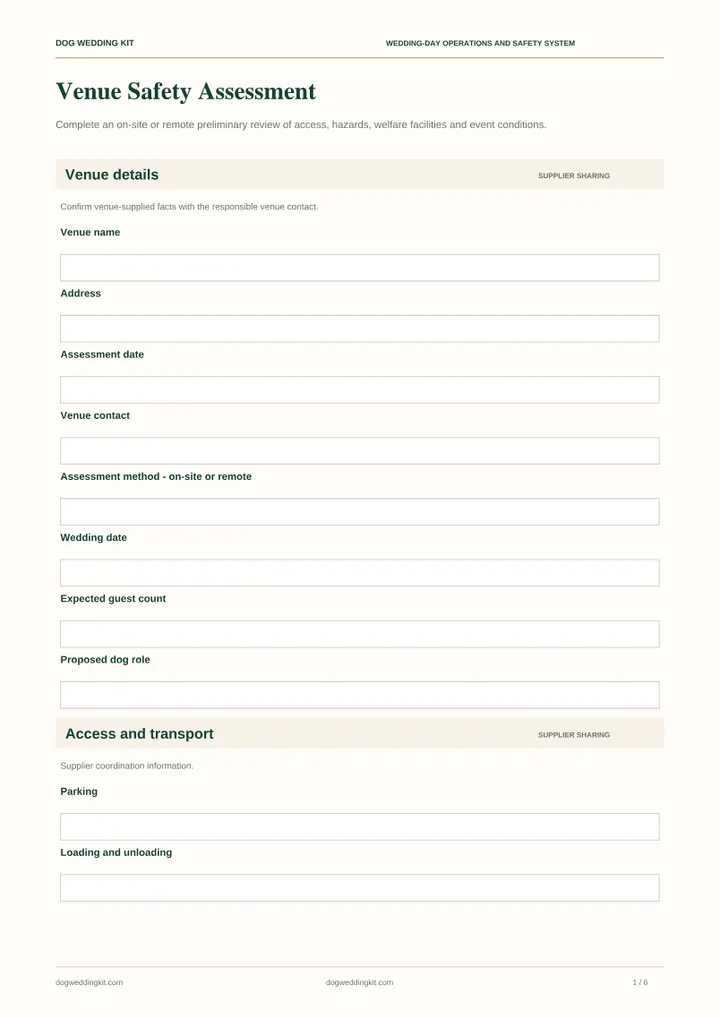
Dog Wedding Kit can help organise business readiness, client information, service scope, venue planning, risk documentation, transport authorisation, incident records, pricing and wedding-day operations. Those records can make conversations with advisers more precise.
It does not provide or verify insurance, replace a broker, give legal advice, register a business, determine worker status or guarantee regulatory compliance. Templates must be customised and checked against the operator's real service and location.
Professional operating resources
Turn verified requirements into a service you can run
Use the editable business, client, safety, venue and operations resources to record decisions and maintain a coherent service—after checking insurance and local requirements with the right professionals.
19 · Sources and verification
Authoritative starting points
- United Kingdom: GOV.UK animal-activity licensing guidance for England, including home boarding; Great Britain animal-transport guidance; and Business.gov.uk insurance guidance.
- United States: US SBA business registration guidance, licence and permit guidance, and Pet Sitters International professional standards for pet-care insurance terminology and risk-management practice.
- Australia: Business.gov.au insurance guidance, licence and permit guidance, ABLIS, and Safe Work Australia regulator contacts.
Sources were reviewed on 15 August 2026. Always check the current page, underlying rules and the authority responsible for your exact location and activity.
20 · Frequently asked questions
Dog wedding chaperone insurance FAQs
What insurance does a dog wedding chaperone need?
There is no universal policy list. Describe every activity you perform, including dog care, weddings, transport, property access, additional handlers and overnight care, to a qualified insurer or broker in your jurisdiction. Ask which cover is legally required and which policy wording responds to your actual risks.
Is public liability enough for a dog chaperone?
Do not assume so. Public or general liability commonly concerns third-party injury and property damage, but exclusions may affect animals or property in your care, transport, employees, home access or overnight services. The full policy wording and insurer confirmation control.
What is care, custody and control insurance?
In pet-care insurance, care, custody and control is terminology often used for cover involving clients' pets or property while they are entrusted to the business. It may be an extension or a differently named section, and its scope, exclusions and limits vary. Ask how the policy treats the dog itself.
Do I need different insurance if I transport dogs?
Possibly. Personal motor cover may not automatically include the business use or animal-transport activity you plan. Check both the vehicle insurer and pet-business insurer, along with applicable animal-welfare or commercial transport rules, before relying on cover.
Do I need insurance for overnight care?
Overnight care changes the duration, location and nature of responsibility. It may affect policy eligibility, premises or home insurance and local boarding or animal-activity licensing. Tell the insurer exactly where the dog stays and verify the rules in that location.
Can wedding venues ask for proof of insurance?
Yes, a venue or planner may make current insurance evidence, particular wording or a limit part of its supplier process or contract. That request is not the same as a universal legal requirement, and meeting it does not guarantee preferred-supplier status.
Do I need a licence to be a dog wedding chaperone?
The job title alone does not answer the question. Licensing depends on the activities and location: event attendance, walking, transport, care in the owner's home, daycare and boarding at the provider's home may be treated differently. Check national, state or regional and local authorities.
Should I tell my insurer when I add wedding services?
Yes. Give the insurer or broker an accurate description before relying on the policy for a new activity. Recheck when you add transport, overnight care, staff, more dogs, new premises or a wider service area, and keep written confirmation with the current policy records.
Clarity before the booking
Describe the work, verify the rules and keep the proof current
A professional insurance conversation starts with the full service, not a policy name. Recheck cover and local requirements whenever transport, premises, people, dog numbers or packages change, then keep operations aligned with what was declared.
For product formats and scope, see the Dog Wedding Kit FAQs. For package boundaries, read the pricing and packages guide.