

Client and operations guide
Dog Wedding Chaperone Forms and Paperwork
A practical way to collect the right information, separate client forms from internal records and arrive at the wedding with a clear working pack.
Good paperwork reduces confusion. It should capture important information once, organise it securely and make decisions easier—not bury clients in bureaucracy.
Published 15 August 2026 · By Dog Wedding Kit

A wedding dog service brings together client expectations, individual care, venue rules, supplier timing, emergency contacts, transport and handover. A structured record gives each detail a reliable home.
Paperwork cannot prevent every misunderstanding or incident, and a signed form does not replace competence, insurance or professional judgement. Its practical job is to make the agreed service visible and give the chaperone current information when it matters.
This guide owns the forms and record-keeping process. Use the startup guide for the wider business, the safety guide for detailed welfare planning, the venue and planner guide for professional coordination, and the pricing guide for package and pricing decisions.
Use the free printable startup checklist to identify which client and operational documents your first service actually needs.
This guide explains document purposes, not universal wording. Contracts, consumer rights, cancellation terms, liability, privacy, transport, veterinary authority, property access and media consent vary by jurisdiction and service. Local legal, insurance or other professional review may be appropriate.
01 · Paperwork workflow
From enquiry to handover
Collect information in stages. The couple should not have to answer wedding-week questions before you have confirmed that the date, location and basic service are a fit.
- 01EnquiryCollect enough to assess fit and availability.
- 02DiscoveryClarify the wedding plan and service request.
- 03Dog informationRecord routine, handling and care details.
- 04SuitabilityComplete the provider’s internal assessment.
- 05VenueConfirm policy, routes, spaces and contacts.
- 06BookingSummarise scope, price, terms and permissions.
- 07Final detailsConsolidate the current wedding plan.
- 08Wedding dayCarry only the working documents needed.
- 09HandoverConfirm the dog, equipment, keys and updates.
- 10Post-eventComplete factual records and follow-up.
02 · Paperwork principles
Structured paperwork should reduce work, not multiply it
A professional system supports clear expectations, dog welfare, venue logistics, emergency preparation, service scope, safe handover and appropriate business records. It also helps a provider distinguish what the client stated from what the provider later assessed or observed.
Avoid unnecessary forms
- Ask a question once and reuse the confirmed answer
- Combine closely related information where that improves clarity
- Use conditional questions for medication, transport or property access
- Write in plain language and explain why sensitive details are needed
- Separate provider worksheets from forms the client must complete
- Collect only information relevant to the service
- Review old answers instead of automatically requesting everything again
One concise onboarding form may cover client contact, dog basics and emergency details, while optional sections appear only when relevant. A business offering collection from accommodation needs access instructions; a venue-only provider may not. Proportionate paperwork follows the actual service.
Client-facing
Questions, summaries and permissions only the client can supply or confirm.
Internal business
Provider assessments, notes, finance reviews and decision records.
Wedding-day operational
Current timelines, run sheets, care schedules, checks and handover.
Supplier coordination
Relevant contacts, timings, access and logistics shared on a need-to-know basis.
Review recommended
Terms, privacy, authority and access wording that may need local professional input.
03 · Enquiry and discovery
Start with enough information to decide the next step
Initial enquiry form
Keep the first contact short. Useful fields usually include client name and contact method, wedding date, venue or general location, number of dogs, basic service request, approximate timing, likely collection or handover and how the client heard about the service. Avoid asking for full addresses, access codes or detailed health information before there is a reason to hold it. Guide 8 explains how enquiry sources and follow-up fit into client acquisition.
Client discovery questionnaire
After confirming basic fit, explore the wedding plan: where the dog will be, ceremony involvement, photography, transport, supplier coordination, rest and departure. Ask about special requirements that affect quoting or feasibility. Discovery should reveal the shape of the booking without becoming the final operating plan.
Consultation notes
Internal notes can capture decisions, questions to resolve and the provider’s follow-up actions. Separate them from client-submitted answers so observations are not mistaken for the client’s words. Record facts and relevant professional reasoning; avoid unnecessary sensitive or subjective commentary.
04 · Dog information
Build one practical picture of the individual dog
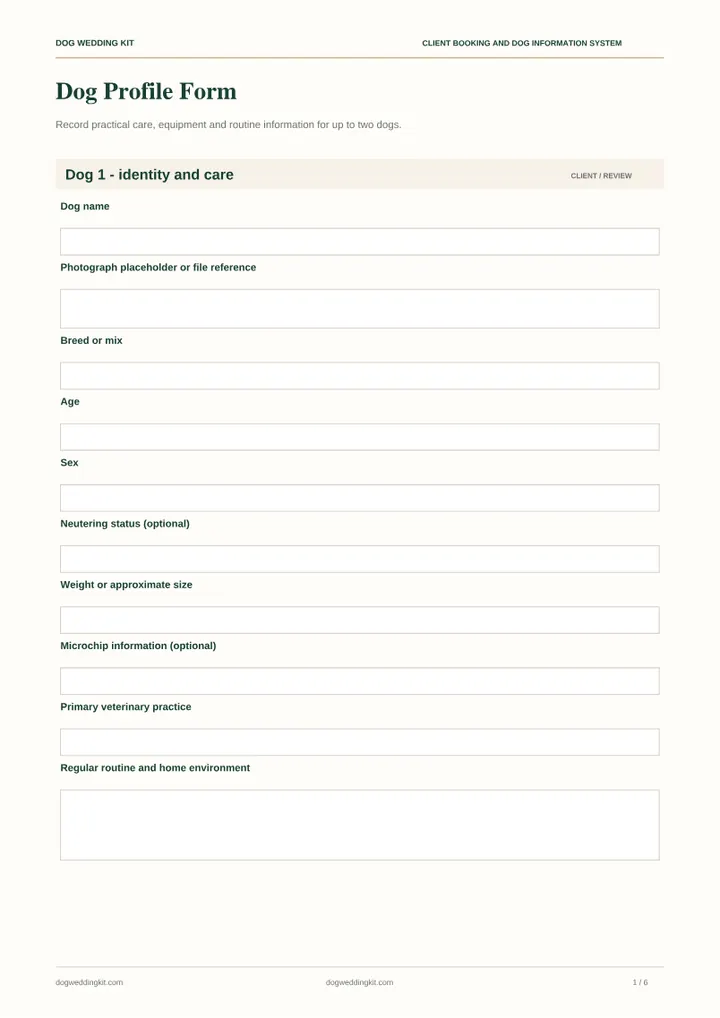
Dog profile
Record name, age, normal routine, handling, equipment, feeding, toileting, known preferences and owner instructions. Keep the working summary concise enough to use.
Behaviour and temperament
Ask how the dog responds to crowds, children, unfamiliar people, dogs, noise, travel, handling and separation. Record reported behaviour without diagnosing it. Link the answers to an internal suitability assessment.
Feeding and routine
Confirm food, timing, approved treats, water, walks, toileting and rest. Make clear what the owner supplies and what deviations are permitted.
Medication and health
Document relevant owner instructions and veterinary directions where applicable. Confirm the provider’s competence, insurance and local requirements. A form is not medication advice or authority beyond its valid scope.
Veterinary information
Keep the regular practice, client and backup emergency contacts, useful telephone numbers and a suitable local emergency option. Any authority to seek treatment needs locally appropriate wording.
Meet and greet
Verify identity, equipment fit, handling cues, loading or travel routine, access, food, medication process and handover expectations. Record differences between the written answers and what is demonstrated.
Use the dog wedding safety checklist for deeper suitability, body-language, weather, transport and emergency planning. Forms organise the information; they do not diagnose behaviour or make participation suitable.
05 · Venue and suppliers
Record the logistics that connect the dog to the wedding
Wedding venue information form
Capture the venue contact, published or confirmed dog policy, access time, parking, correct entrance, ceremony and photography areas, quiet rest space, toileting, weather alternative, arrival and departure route and any requested supplier documents. Use the venue and planner partnership guide for the full conversation and visit process.
Wedding supplier contact sheet
Include only people relevant to the dog plan: planner or coordinator, venue lead, photographer, and a groomer, pet sitter or other pet professional when they have an agreed role. Do not collect the entire supplier list simply because it exists.
Wedding-day coordination questionnaire
Bring the dog’s timeline together: arrival, ceremony cue and role, portraits, rest, movement, departure and handover. Record who approves changes and who needs an update. This document translates the dog plan into the existing wedding schedule rather than creating a competing schedule.
06 · Permissions and access
Separate essential authority from optional marketing consent
Transport authorisation
State which dog, journeys, collection and destination are covered and who may hand the dog over. Vehicle, restraint, insurance and legal requirements vary; use locally reviewed wording where appropriate.
Photography permission
Distinguish photographs needed to document the service from images created by the wedding photographer and any later marketing use. Attendance at a wedding is not automatic permission to publish.
Social media permission
Make marketing consent explicit, informed and optional. Do not hide it inside essential care consent or make refusal appear to affect service quality.
Property and key access
Record authorised locations, dates, key or code handling, return and handover. Limit who can access the information and avoid placing usable codes in an insecure wedding-day pack.
These records document an agreed scope; they do not guarantee protection from liability. Privacy, transport, property access and consent wording should reflect local law, insurance conditions and the service actually offered.
07 · Booking documents
Make the booked service easy to verify
Booking summary
Give the client a plain-language summary of the date, venue, dog, package, key timings, collection, handover, major extras and contacts. It should sit alongside—not contradict—the detailed agreement and current wedding plan.
Payment schedule
Record the agreed total, any deposit or booking payment, payments received, remaining balance and due dates. Do not prescribe a universal deposit percentage. The dedicated pricing and packages guide explains how scope and pricing connect.
Service agreement or terms
A written agreement may address service scope, payment, cancellation, client responsibilities, dog information, transport, emergency arrangements, property access and separate media choices. Do not copy a generic contract and assume it works globally. Consumer rights, cancellation and refund rules, liability language and signatures may require local legal review.
Give each confirmed booking and wedding-day summary a date or version. When something changes, update the current document and make clear which earlier copy is superseded.
08 · Internal preparation
Keep provider assessments away from the client’s form queue
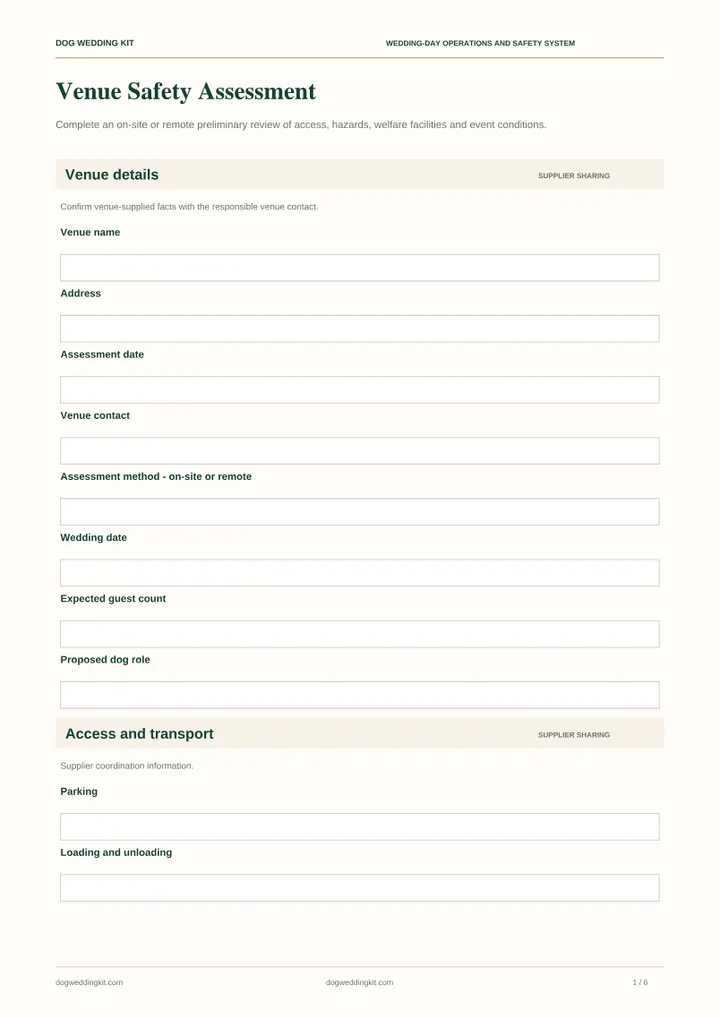
A dog suitability assessment is normally the provider’s operational judgement, informed by the client’s answers, meet and greet, proposed environment and the provider’s competence. A venue safety assessment similarly records access, escape points, weather, quiet areas, food hazards, ceremony route and transport. Neither needs to be presented as another questionnaire for the couple.
Other internal checks may cover the meet and greet, equipment, packing, route, staff briefing and outstanding decisions. Share a relevant conclusion or action with the client; do not automatically share every internal note.
09 · Wedding-day operations
Convert planning into documents that work under pressure
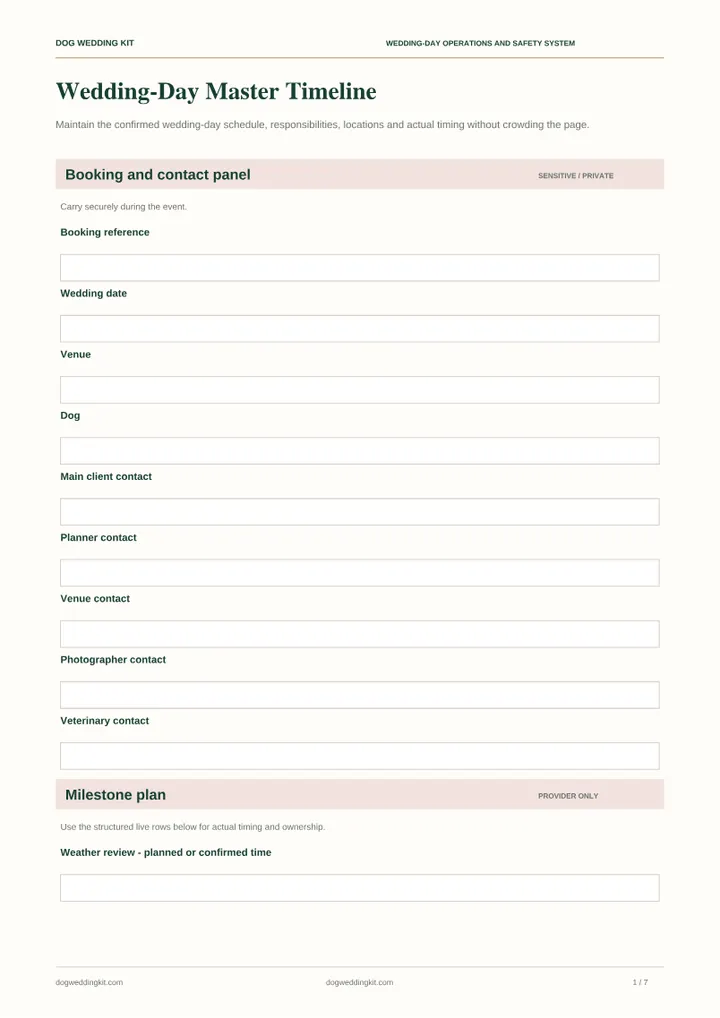
Master timeline
Consolidate time, location, task, dog need, supplier contact and contingency. One current timeline is safer than conflicting fragments in messages.
Handler run sheet
Create an internal sequence of actions, checks, contacts and decision points. It can be more detailed than the client-facing summary.
Dog packing checklist
Confirm restraint equipment, familiar care items, water, food or treats, waste supplies, weather items, cleaning materials and agreed medication where applicable.
Food, water and rest schedule
Place routine care into the day deliberately. These simple needs are easily displaced when ceremony and photography timings move.
Photography coordination
Record timing, permitted locations, photographer contact, handler role, lead management, breaks and the efficient exit plan.
Ceremony positioning
Map entry, position, handler, cue, exit and backup. Confirm who holds the lead at every transition.
Weather plan
Identify forecast checks, shade or shelter, surface changes, alternative spaces, decision contact and the point at which participation changes.
Emergency response
Keep the checklist short: contacts, location, immediate safe actions, veterinary route, notifications and essential records. It is not a medical treatment manual.
Lost dog response
Organise the current photograph and description, client and venue contacts, microchip information where relevant, exit management and appropriate local services. Avoid uncontrolled pursuit instructions.
Handover plan
Name the authorised recipient, place, time, equipment, keys and information to transfer. Define the fallback if the person is unavailable.
For detailed safety content behind these summaries, return to the safety and welfare guide.
10 · Handover and records
Close the booking as carefully as it began
Incident report
Record the time, location, what was observed, actions taken, people notified and handover. Use factual language. Do not assign blame, diagnose the dog or rewrite uncertain details as facts. Follow insurance, legal or regulatory notification requirements where they apply.
End-of-day handover checklist
Confirm the authorised person, dog’s observed condition, equipment, any relevant food or medication update, property keys and access items, and information passed on. Ask the recipient to clarify discrepancies before responsibility changes.
Post-event service report
A short report may note delivered timings, dog care, material changes, handover and actions still open. Keep the client version useful and the internal record proportionate. Routine reporting should not become a substitute for immediate communication about a concern.
Feedback and review request
Ask for genuine feedback after the service is complete. A public review is optional, and permission to quote a message, use a name or publish an image must be clear. Never convert private feedback into a testimonial without consent.
11 · Who completes what?
Keep the client’s paperwork list short
| Document group | Typical owner | Practical approach |
|---|---|---|
| Enquiry and discovery | Client supplies; provider reviews | Use a short enquiry followed by deeper questions only when fit is established. |
| Dog and emergency information | Client supplies; provider verifies | Combine routine details intelligently and separate sensitive sections where useful. |
| Booking, terms and permissions | Provider prepares; client confirms | Make scope plain and keep optional marketing consent distinct. |
| Suitability and safety assessments | Provider internal | Use client information as input, then record the provider’s decision separately. |
| Timeline, run sheet and checklists | Provider leads | Confirm relevant facts with the client and suppliers; keep working detail internal. |
| Incident and post-event records | Provider creates | Record facts and share only what is appropriate or required. |
Client-facing documents may be combined into a staged onboarding and confirmation process. Internal documents can include suitability, venue safety, run sheets, packing, incident notes and profitability review. Venues and suppliers should receive only the coordination summary, timing, access and relevant safety or logistics they genuinely need—not a complete client file.
12 · Information protection
Protect the records you ask people to trust you with
- Collect only information needed for a stated purpose
- Explain how client information will be used
- Limit access to people who need it for the service
- Use appropriate safeguards for paper and digital records
- Avoid sending sensitive files through unnecessary channels
- Keep access codes separate from widely shared schedules
- Maintain a justified retention and deletion policy
- Review information for accuracy before the wedding
- Dispose of records securely when they are no longer required
- Follow applicable privacy, breach and access-request rules
Do not invent a universal retention period. Tax, insurance, limitation, consumer, veterinary and privacy obligations vary. Decide what each record is for, how long that purpose lasts and whether local rules require a minimum or maximum period.
Current privacy guidance from regulators such as the UK ICO and US FTC emphasizes data minimisation, justified retention, controlled access, secure storage and secure disposal. Apply the law and regulator guidance relevant to your business location and clients.
13 · Formats and event pack
Choose the format around the task
| Format | Useful for | Watch for |
|---|---|---|
| Editable Word | Customising language, questions, branding and internal procedures. | Layout can vary between software; protect completed sensitive files. |
| Fillable PDF | Consistent client completion without changing the document structure. | Test field order, mobile use, saving and accessibility. |
| Print PDF | Meet-and-greet checks, manual backup and concise wedding-day pages. | Printed copies become outdated; secure and dispose of them appropriately. |
| Spreadsheet | Pricing, payments, document status and business-level tracking. | Do not carry unrelated financial or client data to the event. |
What should travel with the chaperone?
- Current dog care summary
- Client and backup emergency contacts
- Relevant veterinary information and authority
- Venue address, access and named contact
- Master timeline or handler run sheet
- Weather and emergency summary
- Collection and handover details
- Essential permissions where they may need to be evidenced
- Blank incident notes or a secure recording method
The full client folder, marketing permissions, financial workbook and old drafts do not belong in the event bag. Carry the minimum current information necessary, secure it during travel and dispose of temporary copies properly.
14 · Common mistakes
Avoid paperwork that creates new risk
- Sending several forms that ask the same questions
- Collecting irrelevant personal or medical information
- Missing client, backup or veterinary contacts
- Bundling optional marketing consent into required care information
- Copying generic contracts without local review
- Using vague filenames or no document version
- Missing confirmation or signatures where valid consent requires them
- Carrying outdated schedules or dog information
- Storing keys and access codes insecurely
- Sharing complete client files with suppliers
- Writing blame or diagnosis into incident notes
- Keeping information indefinitely without a reason
15 · A manageable starter system
Give each type of record one obvious home
- ClientContacts, enquiry, discovery and communications.
- Dog informationProfile, routine, health and emergency details.
- VenuePolicy, contacts, access and coordination.
- BookingSummary, terms, permissions and payment record.
- Wedding dayTimeline, run sheet, packing and care schedule.
- SafetySuitability, venue, weather and response plans.
- HandoverAuthorised person, equipment, keys and updates.
- FinanceQuotes, invoices, payments and internal review.
Use a stable booking identifier or naming pattern and keep one current source for each critical fact. Archive superseded versions so they cannot be mistaken for live instructions. A simple folder structure used consistently is better than a complicated platform nobody maintains.
Documents that may deserve professional review
Depending on jurisdiction and service, consider review of service agreements and terms, cancellation and refund language, liability provisions, privacy and data handling, property access, transport authority and consumer-law wording. Not every checklist needs a lawyer; the point is to identify documents that create legal obligations rather than assuming a template settles them. Use the insurance and business requirements guide for the related coverage, registration and licensing questions.
16 · Complete paperwork checklist
Dog wedding chaperone paperwork checklist
First enquiry
- Contact and preferred reply method
- Wedding date and location
- Dog number and basic request
- Approximate timing and transport need
Before booking
- Discovery complete
- Service fit reviewed
- Scope and price summarised
- Terms and payment schedule ready
Dog information
- Profile and routine
- Behaviour information
- Health or medication instructions
- Emergency and veterinary contacts
Venue
- Policy and permitted areas
- Access, parking and contact
- Rest, toileting and weather space
- Ceremony and photography routes
Authorisation
- Transport where offered
- Veterinary framework where appropriate
- Property or key access where needed
- Separate optional media consent
Wedding preparation
- Meet and greet recorded
- Suitability and venue assessment
- Supplier contacts
- Final coordination questionnaire
Wedding day
- Current timeline and run sheet
- Packing and routine checks
- Photography and ceremony plan
- Handover details
Safety
- Weather summary
- Emergency contacts and response
- Lost dog information
- Secure recording method
Handover
- Authorised recipient verified
- Dog and equipment transferred
- Keys and access items returned
- Relevant updates communicated
After the event
- Factual report or incident record
- Payments and actions closed
- Records stored or disposed of correctly
- Optional feedback request
17 · Ready-made systems
Build your own—or start from an organised structure
A provider can create every document around their own service. The advantage is complete control; the cost is the time needed to map questions, remove duplication, design usable versions and maintain the system.
Dog Wedding Kit provides editable client, dog, venue, wedding-day and safety resources such as the Dog Profile Form, Wedding Venue Information Form, Wedding-Day Coordination Questionnaire, Master Timeline and handover checks. They are organisational starting points, not universal legal documents, and still require customisation and local review where appropriate.
Client and operations resources
Start with connected forms instead of isolated downloads
Explore the client booking, dog information, venue, safety and wedding-day workbooks, with editable and practical output formats designed to be customised for a real service.
18 · Research note
What current practice suggests
Current wedding pet enquiry forms commonly begin with the date, venue, dog and approximate arrival or service requirement. Broader pet-care systems add pet profiles, care routines, emergency veterinary information, terms and key access. That market pattern is useful for identifying common needs, but competitor forms and clauses are not legal authority.
- Wedding Pet Attendant Information Form illustrates wedding-specific arrival, venue and photographer fields.
- VIPDOGS wedding enquiry process illustrates the concise date, venue and dog starting point.
- Time To Pet sample agreement guidance distinguishes service agreements, veterinary release and key handling while recommending legal review.
- UK ICO data-minimisation guidance and US FTC business security guidance illustrate why collection, access, retention and disposal should be deliberate.
19 · Frequently asked questions
Dog wedding chaperone paperwork FAQs
What forms does a dog wedding chaperone need?
A proportionate system normally covers enquiry and discovery, dog care information, emergency contacts, venue and supplier details, booking scope, necessary permissions, wedding-day operations, handover and any incident record. The exact documents depend on the service offered, local requirements and how information is combined.
Do clients need to complete every form?
No. Clients should complete or confirm the information and permissions only they can provide. Suitability assessments, venue safety reviews, run sheets, packing checks and many operational records are normally completed internally by the provider.
Do I need a dog profile form?
A structured dog profile is useful because it keeps routine, handling, equipment, feeding and owner instructions together. It can be combined with other client information when that produces a shorter, clearer process.
Do I need veterinary information?
Emergency contacts and veterinary information may be important when you have responsibility for a dog. Collect what is relevant to the service, understand your competence and authority, and obtain locally appropriate wording or professional review for any veterinary authorisation.
Should photography permission be separate?
Distinguish operational photography from marketing use. Optional consent to publish images should be explicit and should not be hidden inside essential care information. The right structure depends on your service, privacy obligations and local law.
What paperwork should I carry on wedding day?
Carry a concise current pack: key contacts, dog care summary, timeline or run sheet, venue details, emergency information, essential permissions where needed, and handover details. Avoid taking complete client or business files when they are not required.
Do I need a service agreement?
A written agreement or terms can record scope, payment, cancellation, client responsibilities and other important expectations. It is not universal legal protection. Local legal review may be appropriate, especially for liability, consumer rights, transport, property access and privacy wording.
Can I create the forms myself?
Yes. A provider can build a clear system around the service they actually offer. Ready-made editable forms can reduce setup time, but they still need to be customised, checked for duplication and reviewed against local legal, insurance and professional requirements.
A calm system behind the service
Capture important information once, then make it useful
The strongest paperwork process is proportionate: clients answer clear questions, the provider completes professional assessments, suppliers receive only relevant logistics, and the chaperone carries a concise current pack. Review the system after real bookings and remove anything that does not improve care, clarity or accountable business records.
For product format and licensing questions, see the Dog Wedding Kit FAQs.