

Marketing and client acquisition guide
How to Market a Dog Wedding Chaperone Business
Build a practical route from first discovery to a qualified enquiry—without relying on one platform, constant posting or promises of instant bookings.
Many couples do not yet know this specialist service exists. Good marketing must help them discover it and understand, quickly, why professional dog care could improve their wedding plan.
Published 15 August 2026 · By Dog Wedding Kit

The goal is not maximum traffic or the largest follower count. It is a steady flow of suitable couples who understand the service, fall within the operating area and are ready to discuss a realistic booking.
A specialist service benefits from several connected discovery routes: direct search, wedding suppliers, existing pet-care relationships, useful content, social proof and referrals. No single channel guarantees a result, so build a system that can be measured and adjusted.
This guide owns broad marketing and client acquisition. Use the venue and planner guide for detailed relationship management, and the startup guide for the wider launch sequence.
Before promoting the service, work through the free Dog Wedding Chaperone Startup Checklist so your website and outreach rest on clear operational foundations.
Platform features, directory models, advertising rules and direct-marketing law vary by country and change over time. Verify current eligibility and policies in your market, obtain consent and permissions where required, and do not treat a marketing tactic as guaranteed performance.
01 · Client acquisition flywheel
How dog wedding chaperone marketing fits together
This is a reinforcing sequence, not an automatic growth machine. Each stage still depends on service quality, fit and consistent work.
- 01
Professional service
A clear, deliverable offer with welfare-led boundaries.
- 02
Clear website
Explain what happens, where and for whom.
- 03
Local discovery
Help nearby couples find accurate information.
- 04
Supplier relationships
Build trusted routes through relevant professionals.
- 05
Useful content
Answer the questions couples ask before enquiring.
- 06
Qualified enquiries
Make fit, location and next steps easy to assess.
- 07
Client experience
Deliver the careful service that marketing promised.
- 08
Reviews and referrals
Invite honest feedback and permission-led advocacy.
02 · Marketing foundation
Get the service clear before promoting it
Define the service area, package scope, dog suitability process, wedding-day responsibilities, transport approach, pricing presentation, overnight care if offered and professional boundaries. Marketing becomes easier when the offer is operationally true.
Use what a dog wedding chaperone does to define responsibilities and the pricing and packages guide to shape an understandable offer.
Choose the audience before the message
Engaged couples
Lead with the practical and emotional problem: including their dog without asking a guest or supplier to become the handler.
Wedding suppliers
Explain role clarity, coordination and how a dedicated professional reduces avoidable dog-related disruption.
Existing pet clients
Introduce a relevant additional service to people who already know the standard of care, without repeatedly messaging an entire list.
Pet professionals
Show how mutual referrals could help dog-owning clients while preserving each provider’s scope and independence.
The same facts can be framed differently for each audience. Couples need an easy-to-understand outcome; a planner needs confidence about responsibilities; a groomer needs a sensible client handoff.
03 · Channel priority
Build foundations before adding channels
Not every business needs every channel. Choose the smallest useful mix for the service area, audience, time and budget.
Foundation
- Website
- Clear service packages
- Contact process
- Real imagery
Local discovery
- Google Business Profile where eligible
- Local search
- Wedding directories
Relationships
- Venues
- Planners
- Photographers
- Pet professionals
Content
- Helpful website guides
- Social media
- Visual discovery
- Short video
Trust
- Genuine reviews
- Permission-led testimonials
- Real case studies
Paid later
- Search ads
- Social ads
- Directory upgrades
04 · Website conversion
Explain the service before asking for an enquiry
A focused website can contain a homepage, services or packages, a pricing framework, about page, FAQs and a contact or enquiry route. State the real service area and use real imagery. More pages are not automatically better; avoid dozens of thin location pages.
What should the homepage communicate?
- What a dog wedding chaperone is
- The area served
- The problem the service solves
- The main service or package choices
- How dog welfare shapes the plan
- Relevant experience and professional preparation
- What happens after an enquiry
- A clear route to enquire
A poetic headline can support the page, but it cannot replace a plain service explanation. A visitor should not need to interpret vague wedding lifestyle language to discover who handles the dog.
Show real packages and a useful price signal
Clear package scope reduces unsuitable enquiries and helps suppliers describe the service accurately. Publish exact prices, starting prices or a clear custom-quote framework according to the real business model. Explain what changes a quote rather than hiding all commercial context.
Use photographs that prove the work
Prioritise the handler, dogs, venue environments, equipment, quiet rest, movement and real coordination. Obtain permissions and credit professional photographers as agreed. Styled shoots can be useful, but label them honestly rather than presenting them as paid client weddings.
05 · Local search
Help searchers understand the service and the area
Use consistent business details, a clear service area, descriptive titles and metadata, natural location information, useful internal links and evidence of genuine local activity. Explain actual travel boundaries and venue considerations. Do not create near-identical town pages solely to manipulate rankings.
Local search is also connected to real-world reputation: supplier relationships, directory profiles, articles, mentions and reviews can help people—and search systems—understand the business. Keyword repetition cannot substitute for relevance or credibility.
Google Business Profile may fit an eligible service-area business
Google’s current guidance says eligible businesses generally make in-person contact with customers. It permits a service-area model for businesses that travel to customers, while online-only businesses are ineligible. A chaperone who physically visits clients or venues may fit that model if the business meets all current rules, but this guide cannot guarantee approval.
Set up the profile accurately if eligible
- Use the real-world business name without added keywords
- Select the closest accurate category currently available
- Do not invent a category called Dog Wedding Chaperone
- Enter a precise service area rather than claiming everywhere
- Use an authoritative website and working phone number
- Keep available hours and contact details current
- Describe actual services and package boundaries
- Add genuine, permission-cleared photographs and updates
- Retain control of the profile if another person helps manage it
Do not use a fake office or virtual address
Google says a service-area business that does not serve customers at its address should remove that address and show only the service area. Its representation guidelines also restrict virtual offices unless they meet the stated staffing and customer-service requirements. A borrowed address, mailbox or unstaffed wedding-venue address is not a shortcut to local visibility.
Keep ranking expectations realistic
Google describes local results mainly through relevance, distance and prominence. Complete information, reviews, photos and broader web signals may help, but there is no way to request or pay Google for a better organic local ranking. Verification and activity do not guarantee a top position.
Use real profile photos
Useful categories may include the handler, dogs in safe settings, transport setup where relevant, equipment, behind-the-scenes preparation, venue coordination and real wedding work. Images must represent the service accurately and comply with permissions and Google’s content policy; uploading stock-photo variations is not a trust strategy.
06 · Reviews and testimonials
Invite genuine experience, not a predetermined rating
Reviews help prospective clients understand reliability, communication, dog care and wedding coordination. Google permits asking customers for reviews based on genuine experience, but prohibits incentives, purchased or fabricated reviews, rating manipulation and selectively soliciting only positive feedback.
- Ask a client who actually received the service
- Make the request optional and neutral
- Request an honest review—not a five-star review
- Give a direct platform link for convenience
- Do not offer discounts, gifts or free services in exchange
- Do not ask friends or relatives without genuine service experience
- Do not swap reviews with other suppliers
- Obtain permission before republishing the review as a testimonial
Thank you for trusting me with [dog’s name] at your wedding. If you would like to share an honest review of the service, you can do so here: [review link]. Feedback is optional, and I appreciate the time it takes.
Respond briefly and protect privacy
Thank the reviewer, respond to a relevant detail without exposing private wedding, property, health or dog information, and move complex concerns to a private channel. Do not argue, publish private evidence or reveal facts the client did not choose to make public.
Case studies and testimonials need permission
A genuine case study can explain the client goal, dog, venue logistics, service plan, welfare considerations and outcome. Confirm permission for names, photographs, venue references and quotations. Do not invent stories, alter testimonial meaning or imply anonymity was agreed when it was not.
07 · Relationship-led discovery
Relevant professionals can introduce highly qualified enquiries
Venues and wedding planners
Venues and planners may meet couples at exactly the moment the dog question arises. Offer a clear service explanation and demonstrate professional coordination, but do not treat the relationship as an entitlement to leads. The venue and planner guide covers research, introductions, visits, preferred-supplier conversations and responsible follow-up.
Photographers
A chaperone can help with dog timing, attention, safe waiting and swift movement between portrait locations. Explore referrals or useful content only where the relationship benefits shared clients; do not pressure a photographer to cross-promote or use images outside the licence granted.
Groomers and pet professionals
Groomers, trainers, dog walkers, pet sitters and boarding providers may already serve engaged dog owners. Introduce the service individually, explain boundaries and agree how referrals are handled. Never imply veterinary or behaviour expertise outside your competence.
Start with existing pet-care clients
An established client base may include engaged couples or people who know someone planning a wedding. A relevant service update, website link or personal conversation can be appropriate. Do not add every pet-care contact to repeated wedding marketing without checking permission and local rules.
08 · Directories and wedding fairs
Evaluate access to the audience, not the platform’s headline traffic
Wedding directories vary by market, region and category. Some offer free listings; others charge subscriptions, upgrades or lead fees. Before paying, check whether a suitable category exists, how local couples search, what information appears, contract and renewal terms, lead ownership, response expectations and how source performance can be measured.
Large examples such as The Knot in the US, Hitched in the UK and Easy Weddings in Australia illustrate that supplier marketplaces and commercial arrangements differ. Their own claims do not establish likely return for a specialist local service.
Make a wedding-fair stand immediately understandable
- One plain sentence explaining the service
- Real, permission-cleared photographs
- A concise package or service-area summary
- A simple enquiry or consultation next step
- A calm dog only when the environment is suitable
- A consent-aware way to collect interested leads
- A follow-up note that records the conversation
- Time to meet relevant suppliers as well as couples
Collecting a business card or competition entry does not automatically create permission for unlimited marketing. Explain what follow-up the person is requesting, record consent where required and provide an appropriate opt-out.
09 · Sustainable content
Teach the service instead of trying to post every day
Build a modest set of repeatable themes: what the service does, wedding preparation, dog welfare, behind the scenes, venue coordination, photography logistics, FAQs, package explanations, dog-care expertise and genuine testimonials with permission.
Visual explanation
Use real examples, short educational captions, appropriate location tags and a clear route to enquire. Do not reverse-engineer supposed algorithm secrets.
Answer one question
Explain what happens before the ceremony, how portraits are coordinated, what travels in the event bag or why dogs need rest breaks.
Pinterest or equivalents
In markets where couples use visual planning platforms, link useful checklists, dog wedding ideas and articles to relevant website pages. Test rather than assume traffic.
Build an answer library
Publish substantial answers about service responsibilities, pricing, safety, venues, paperwork and insurance. Do not manufacture hundreds of thin AI pages.
Local content should contain local knowledge
Useful local material can explain the real service area, travel considerations, weather patterns, venue questions or lessons from permission-cleared local work. A near-identical page for every town is not expertise and may confuse visitors.
Lead magnets are optional
A Dog Wedding Planning Checklist, Questions to Ask Before Bringing Your Dog or Wedding Dog Packing Checklist could help the right audience. Create one only when it solves a real question and the follow-up permission is clear. No lead-magnet asset is created in this task.
10 · Enquiry follow-up
Make the next step clear, personal and proportionate
Acknowledge the enquiry, identify missing essentials, invite a consultation when appropriate, prepare the quote only after enough information is known, and follow up thoughtfully. Prompt replies help, but an unrealistic instant quote can omit travel, dog suitability, venue constraints or scope.
Guide 6 explains the enquiry, discovery, booking and follow-up records. Separate transactional booking messages from marketing subscriptions, and check local electronic-marketing rules.
International outreach rules differ
For example, UK ICO guidance distinguishes subscriber types and applies PECR alongside data-protection law; the US CAN-SPAM framework sets requirements for commercial email; and Australia’s ACMA emphasises consent, sender identification and unsubscribe mechanisms. Those examples are not interchangeable, so verify the recipient type, channel and jurisdiction before supplier outreach, newsletters or fair follow-up.
Track the source without adding analytics yet
A simple enquiry field or internal record can capture Google, venue, planner, photographer, pet client, social, directory, wedding fair, referral or another source. Use one primary source plus a note when the journey involved several touches.
| Measure | What it helps answer |
|---|---|
| Qualified enquiries | Did the channel reach people in the area with a plausible service need? |
| Consultations | Did the enquiry contain enough fit and intent to progress? |
| Quotes | Was a specific, deliverable service scoped? |
| Bookings | Did the channel contribute to paid work? |
| Average booking value | Did the channel attract the service mix the business is designed to deliver? |
| Referral or repeat work | Did a strong client or supplier experience create later discovery? |
Followers, impressions and clicks can diagnose attention, but they are not bookings. Keep measurement small enough to maintain consistently.
11 · Channel decisions
Improve, retain or stop based on evidence
If a channel produces no bookings, examine lead quality, message clarity, page experience, follow-up, cost, time and a fair test period. Change one meaningful variable where the channel still fits. Stop or reduce work that does not justify its effort; past spend is not a reason to continue.
Paid advertising comes later
Search ads may reach high-intent local queries, and social advertising may build awareness or reconnect with prior visitors where lawful and technically appropriate. Both need a clear offer, relevant landing page, working enquiry process, defined budget and booking-level measurement. Neither guarantees profitable leads.
Start with a small controlled test only when the foundation is ready. Directory upgrades deserve the same discipline. Do not begin with a large budget simply because organic discovery is slow.
Discounts are not a marketing system
Constant discounting can train clients to wait, hide an unclear value proposition and undermine a premium care position. If a promotion has a legitimate purpose, make the terms truthful and avoid invented deadlines or fake scarcity.
Referral programmes need local review
Informal recommendations may be enough. A structured programme can introduce disclosure, contract, tax, privacy and professional-boundary questions. Do not prescribe a universal commission or let payment undermine an honest recommendation.
12 · Marketing mistakes
Avoid activity that creates noise instead of trust
- Trying every platform at once
- Using a service description that never says who handles the dog
- Sending traffic to a weak or incomplete website
- Publishing fake, swapped, purchased or incentivised reviews
- Using only stock photography
- Sending generic bulk supplier emails
- Failing to state the real service area
- Giving no package or price context at all
- Leaving genuine enquiries without a clear next step
- Treating follower count as client demand
- Copying competitor posts, prices or claims
- Publishing content without a relevant enquiry path
- Keyword stuffing business names or web pages
- Creating fake local offices or doorway pages
- Discounting continually or using fake scarcity
13 · A realistic first quarter
A simple 90-day marketing plan
The plan establishes and tests a system; it does not promise bookings within 90 days.
Build the foundation
- Confirm audience, area, scope and package presentation
- Publish the essential website and enquiry route
- Assess Google Business Profile eligibility and set it up accurately if eligible
- Prepare real, permission-cleared photographs
- Introduce the service selectively to relevant existing contacts
- Create a simple lead-source record
Create discovery routes
- Research and approach suitable venues and planners
- Introduce the service to selected photographers and pet professionals
- Evaluate local directories and one suitable wedding fair
- Publish one or two substantial client questions
- Request honest reviews from genuine completed clients
- Review enquiry quality and missing website information
Strengthen what works
- Compare qualified enquiries, consultations, quotes and bookings by source
- Improve the strongest message and weakest conversion point
- Create a real case study where permission exists
- Formalise only referral processes that need structure
- Stop or reduce low-fit activity
- Consider a small paid test only if the offer and tracking are ready
14 · Pre-launch check
Dog wedding chaperone marketing checklist
Offer
- Audience and service clear
- Area and boundaries stated
- Packages explain fit
Website
- Homepage explains service
- Real images and credibility
- Enquiry route tested
Local
- Details consistent
- GBP eligibility checked
- No fake locations
Trust
- Review request neutral
- Testimonials permitted
- Claims are supportable
Relationships
- Priority partners researched
- Introductions tailored
- Follow-up restrained
Content
- Themes are sustainable
- Questions are specific
- Every CTA is relevant
Enquiries
- Acknowledgement ready
- Discovery captures essentials
- Quotes follow scope
Compliance
- Marketing permissions clear
- Opt-outs respected
- Image rights recorded
Measurement
- Sources recorded
- Useful outcomes defined
- Review date scheduled
15 · Dog Wedding Kit support
Turn the strategy into repeatable marketing work
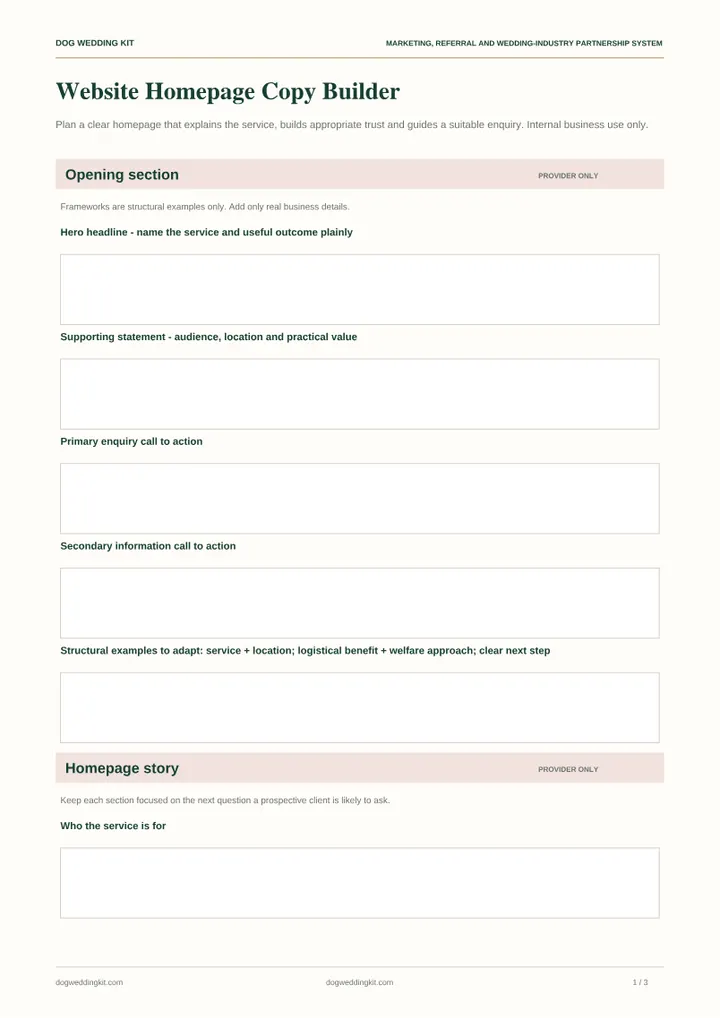
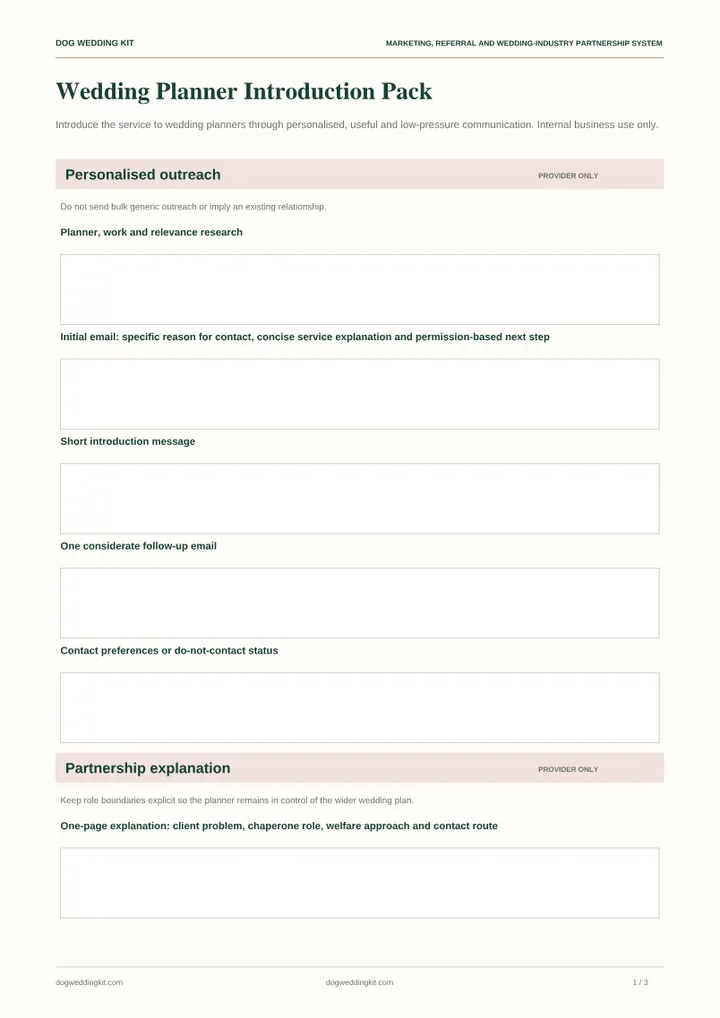
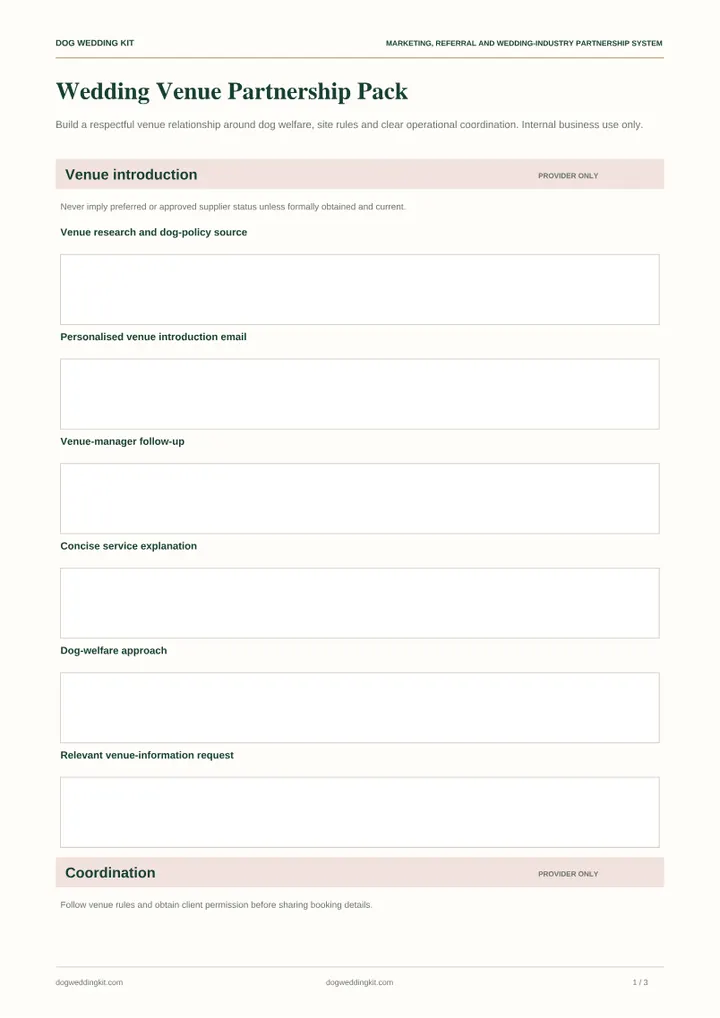
Dog Wedding Kit includes structured resources such as the Brand Positioning and Messaging Workbook, website copy builders, Google Business Profile Copy and Setup Planner, venue, planner and photographer introduction packs, enquiry follow-up emails, a testimonial and review request system, social planning prompts and referral planning.
These resources help organise decisions and customise outputs. They do not create Google eligibility, guarantee rankings or bookings, supply client consent, replace direct-marketing advice or prove that a paid channel will return its cost.
Marketing and partnership resources
Build a connected acquisition system without starting from blank pages
Use editable messaging, website, profile, partnership, follow-up, review and content-planning resources—then adapt them to your actual service, voice, market and local rules.
16 · Sources and policy notes
Current primary guidance
- Google Business Profile: eligibility, business representation, service areas, local ranking, photos and review requests.
- Direct marketing examples: current UK ICO electronic-marketing guidance, US FTC CAN-SPAM business guidance and Australian ACMA spam guidance.
- Directory patterns: supplier-facing pages from The Knot, Hitched and Easy Weddings illustrate different commercial marketplace models, not recommended providers or expected returns.
Sources were reviewed on 15 August 2026. Platform policies, features and availability can change; check the current source before acting.
17 · Frequently asked questions
Dog wedding chaperone marketing FAQs
How do dog wedding chaperones get clients?
A diversified system is usually more resilient than one platform. Start with a clear service and website, accurate local discovery, existing pet-care relationships, relevant wedding suppliers, useful content, genuine reviews and consistent enquiry follow-up. Track which sources produce qualified enquiries and bookings rather than assuming any channel will work.
Should I use Google Business Profile?
Investigate it if your business makes genuine in-person contact with customers and meets Google’s current eligibility rules. A mobile chaperone may fit a service-area model, but eligibility is not guaranteed. Online-only businesses are ineligible, and providers should not use a fake storefront or virtual office to appear local.
Do I need a website?
A focused website gives couples and suppliers a reliable place to understand the service, area, approach, packages, credibility and enquiry process. Social profiles and directories can support discovery, but they provide less control over context, policy changes and the complete customer journey.
Should I advertise prices?
Publish enough information to help couples judge fit. That might be exact packages, starting prices or a clear explanation of what changes a custom quote. Complex travel, multiple dogs or overnight care can still require a tailored proposal. The pricing model should determine the presentation.
How do I approach wedding planners?
Research fit, send a short tailored introduction, explain the practical value to their clients and make the next step easy without demanding referrals. Follow direct-marketing rules where you operate. The venue and planner guide covers the full relationship process.
Are wedding directories worth paying for?
Only when the directory reaches the right local couples and the cost, contract, category fit, lead quality and tracking method make sense. Test against qualified enquiries and bookings, not the directory’s traffic claims alone, and understand renewal or lead-fee terms before paying.
How do I ask clients for reviews?
Ask clients who genuinely experienced the service for honest, optional feedback. Give them a direct review link, do not request a five-star rating, do not offer a reward and do not ask only clients expected to be positive. Obtain separate permission before republishing review text elsewhere.
Should I run paid ads?
Usually only after the offer, landing page, enquiry process and tracking work organically. A small controlled test may help assess high-intent local demand, but search, social and directory advertising do not guarantee leads or bookings. Set a budget and decision rule before starting.
Build discovery around a service worth finding
Make the specialist service clear, credible and easy to enquire about
Start with foundations, choose a manageable channel mix and measure qualified movement—not noise. Let real service quality produce the reviews, case studies and referrals that strengthen later discovery.
For product scope and formats, read the Dog Wedding Kit FAQs.