

Dog wedding service guide
What Does a Dog Wedding Chaperone Do?
A dedicated chaperone looks after the dog while coordinating the practical moments that let them take part in a wedding safely and calmly.
Here is what that can involve before the wedding, at the venue and after the dog’s role is complete.
Published 15 August 2026 · By Dog Wedding Kit
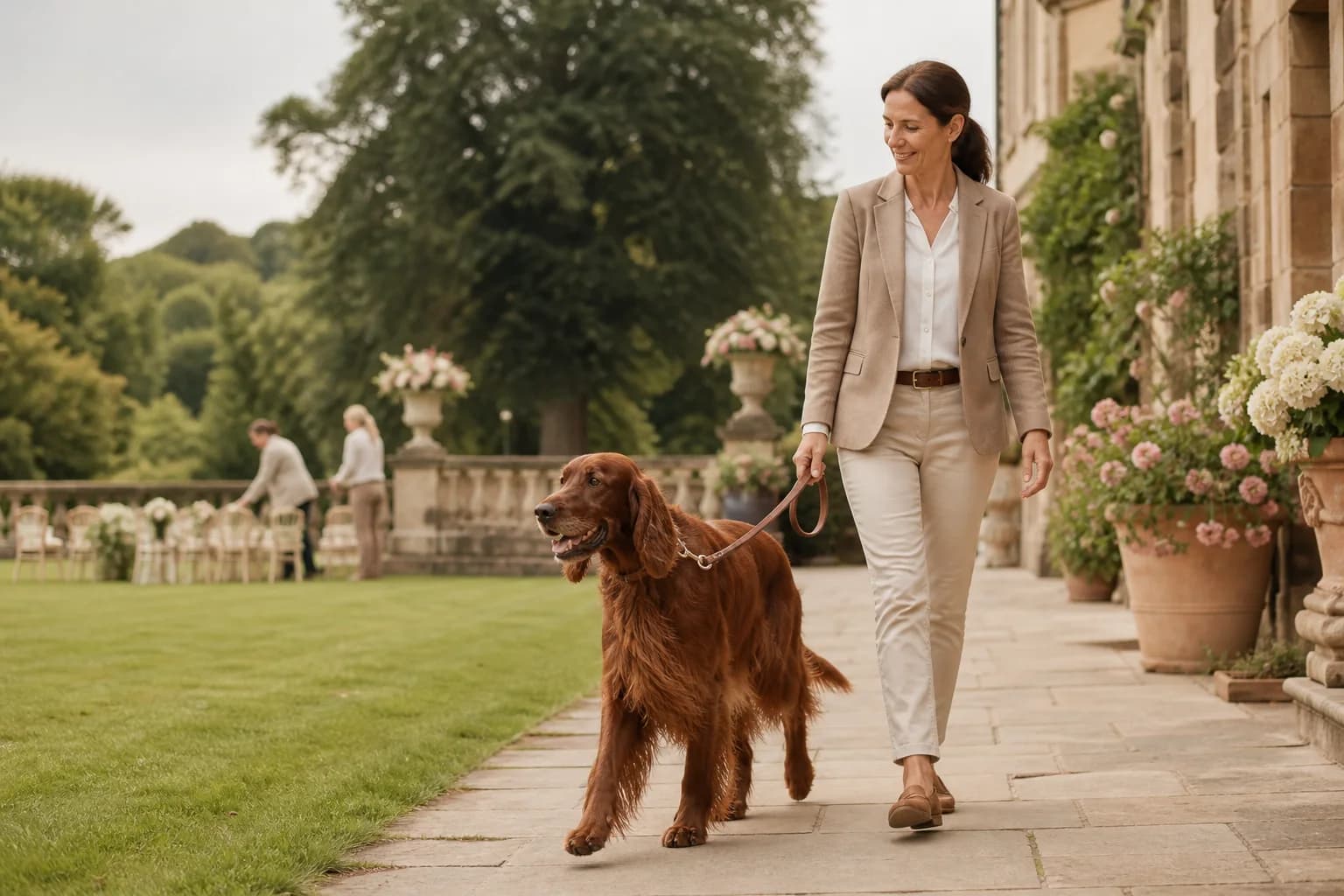
A dog wedding chaperone combines pet-care responsibility with wedding-day logistics. They take charge of the dog’s agreed routine, movement and participation so a guest does not have to leave conversations, miss photographs or watch the clock.
The exact service varies. It can begin with collection from home, include a brief ceremony and portrait appearance, and finish with a return journey. Longer bookings may cover preparation, guest greetings, extended care or an overnight stay. The common thread is one named person concentrating on the dog while working around the wedding plan.
This is not a promise that every dog should attend or that every provider offers every task. The dog, venue, provider’s competence and booked scope determine the right plan.
01 · The role
What is a dog wedding chaperone?
A dog wedding chaperone is a pet-care professional booked to manage a dog’s involvement in a wedding. You may also see the terms wedding dog chaperone, wedding pet attendant or wedding dog handler. Whatever the label, the useful distinction is responsibility: the provider is looking after the dog rather than attending as a guest.
They may coordinate collection, travel, exercise, preparation, ceremony handling, portraits, rest and return care. They also communicate with the venue, planner or photographer about the dog-related parts of the schedule. They do not take over the whole wedding or guarantee that a dog will perform a particular action.
02 · Preparation
What happens before the wedding?
Before the day, the chaperone needs enough information to turn an idea such as “walk down the aisle” into a workable care and logistics plan. That normally means discussing the dog’s routine and handling, health information supplied by the owner, veterinary and emergency contacts, the venue’s rules, travel, timings, food and water, ceremony position, photography, collection and final handover.
The plan should identify a quieter base, safe access route and agreed person to contact if circumstances change. Preparation matters because the couple may be unavailable when the dog arrives, while the wedding team needs concise decisions rather than unanswered questions.
Inside the kit
Keep booking details in one place
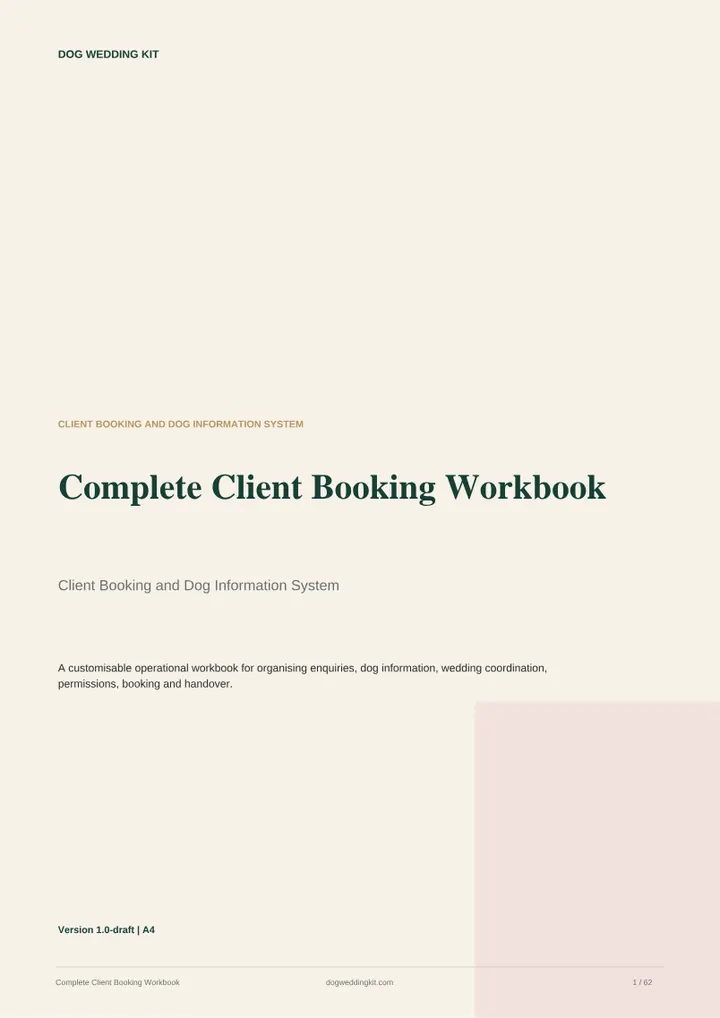
The Complete Client Booking Workbook brings enquiry, dog, venue, supplier, permission and handover information into a structured workflow for the provider to customise.
See the client booking resources →03 · Meet and greet
Meeting the dog beforehand
A pre-wedding meeting lets the dog encounter the chaperone without the pressure of the event. The owner can demonstrate normal cues, lead handling, equipment, routines and any boundaries. The provider can observe how comfortable the dog appears around them and discuss travel or unfamiliar settings.
This is an observation and planning session, not a behavioural diagnosis. If the dog is worried by a stranger handling the lead, cannot settle away from the owner or has needs outside the provider’s ability, the plan may need more gradual familiarisation, a different role or professional input.
04 · Suitability
Checking whether wedding participation is suitable
Some dogs enjoy short, managed social occasions; others do not. The decision should consider the individual dog’s response to travel, separation, crowds, children, unfamiliar dogs, music, applause, handling, photography and the venue itself. Duration and weather can turn an otherwise manageable plan into too much.
A responsible outcome might be a quiet portrait session away from guests, a very brief appearance, or no attendance. Modifying or declining the plan is not a failure. It protects the dog and gives the couple a more predictable day.
Body language should be read in context. Repeated attempts to move away, tense posture, persistent panting unrelated to exercise, tucked posture or an inability to settle warrant a pause and reassessment—not pressure to continue.
The service day
A dog wedding chaperone’s role across the day
Not every booking includes every stage, but this shows how care and wedding logistics can connect from preparation to handover.
- 01
Before the wedding
Confirm the dog, people, places, timings and fallback plan.
- 02
Prepare the dog
Exercise, toilet, offer water and check approved equipment.
- 03
Travel and arrive
Use the agreed transport plan and enter by the confirmed route.
- 04
Settle at the venue
Find the quiet base and let the dog take in the environment.
- 05
Ceremony role
Support the agreed entrance, position or brief appearance.
- 06
Photography
Help with positioning and attention, with breaks when needed.
- 07
Welfare break
Move away from activity for water, toileting, rest and decompression.
- 08
Departure
Leave at the planned time or earlier if the dog needs to go.
- 09
Handover or overnight
Return the dog to the agreed person or begin separate care.
05 · Travel
Collection and transport
Where transport is included, the chaperone may collect the dog from home, boarding accommodation or another agreed address. The plan covers safe loading and restraint, equipment, route and contingency time, parking, venue access, arrival cues and the return journey.
Animal-transport and vehicle requirements differ by jurisdiction, and insurance must match the activity. Couples can reasonably ask how their dog travels and who is authorised to receive them at the end. Providers should verify the rules that apply where they operate rather than relying on another business’s practice.
06 · Arrival
Preparing the dog for the venue
Preparation usually favours calm basics: an appropriate walk, toileting, water, a coat and equipment check, and time to settle. An owner-approved accessory may be added only if it fits safely and does not restrict movement, vision, breathing or communication.
The chaperone should avoid dropping the dog into last-minute bustle. Arriving through the planned entrance and pausing at the quiet base gives the dog a chance to acclimatise before any ceremony cue or camera appears.
07 · Ceremony
Helping the dog take part in the ceremony
The dog might walk down the aisle, sit briefly with the wedding party, greet guests, appear after the ceremony or be involved symbolically as a ring bearer. The chaperone handles the dog to the agreed position, watches their response and leaves cleanly when the moment is complete.
The officiant or coordinator directs the ceremony. The chaperone manages the dog within that direction and needs permission to abandon the planned moment if safety or welfare changes.
08 · Portraits
Working with the photographer
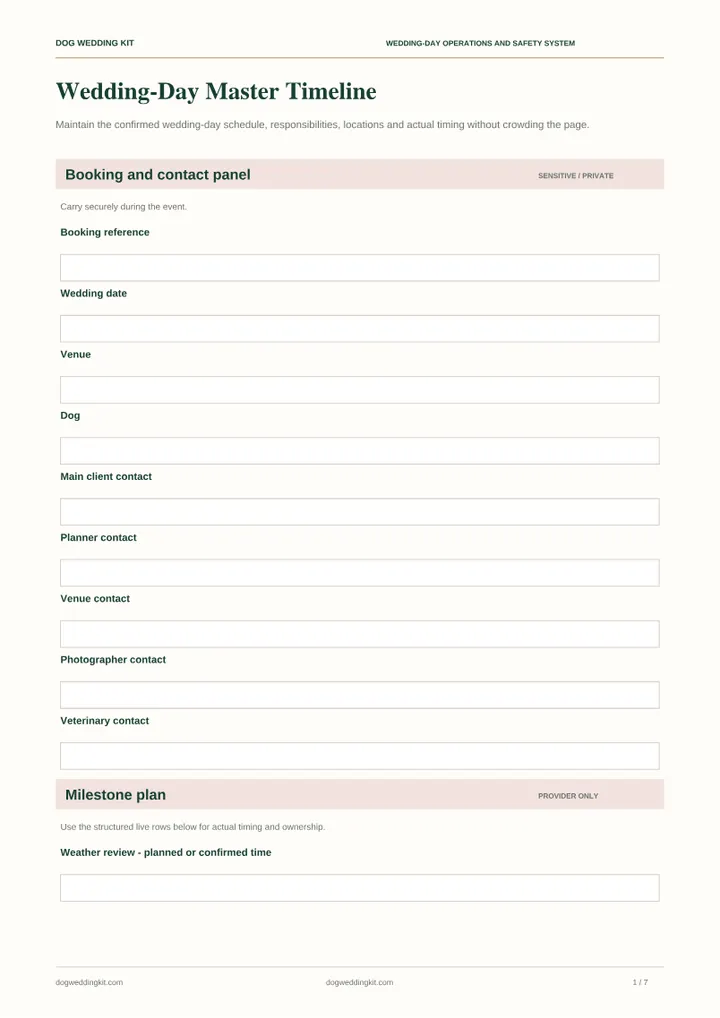
A good photography plan names the approximate window, location and essential groupings before the day. At the shoot, the chaperone can help position the dog, manage the lead, attract attention with approved cues or treats, and move the dog in and out efficiently while respecting the photographer’s direction.
Comfort still sets the pace. Not every image needs a hidden or removed lead, repeated handling can make a dog less cooperative, and a short break is often more useful than another attempt.
09 · Ongoing care
What does the chaperone do while everyone else celebrates?
Much of the value is quiet work outside the photographs. The chaperone supervises the dog, manages greetings, offers water and toilet breaks, follows feeding instructions, chooses suitable exercise or rest, and keeps the dog away from dropped food, decorations, open exits and crowded service routes.
They keep an eye on the timeline without making the dog remain “on duty.” When necessary, they give a concise update to the agreed contact, planner or couple. Otherwise, their work is intentionally unobtrusive.
10 · Welfare
Dog welfare throughout the wedding
Welfare is not a separate box to tick after the schedule is written. It shapes the length of attendance, locations, travel, handling, weather plan and decision to continue. The chaperone should monitor the dog’s whole body and changes from their normal behaviour, while allowing distance and choice where practical.
- Fresh water and appropriate toilet opportunities
- Shade, ventilation and a temperature-aware plan
- A quiet space away from music, crowds and food service
- Rest that is actually uninterrupted
- Short participation windows rather than continuous exposure
- No forced greetings, poses or repeated performance
- A named person and clear authority to end participation
For deeper risk planning, use the dog wedding safety checklist, which covers suitability, venue checks, transport, weather, body language, escape prevention, emergency preparation and handover.
The RSPCA’s dog body-language guidance recommends considering the whole dog and the situation. PDSA guidance stresses shade, water, limiting heat exposure and never leaving a dog in a hot vehicle. If a dog may be unwell, seek veterinary advice rather than trying to diagnose the cause at the venue.
11 · Coordination
Venue coordination
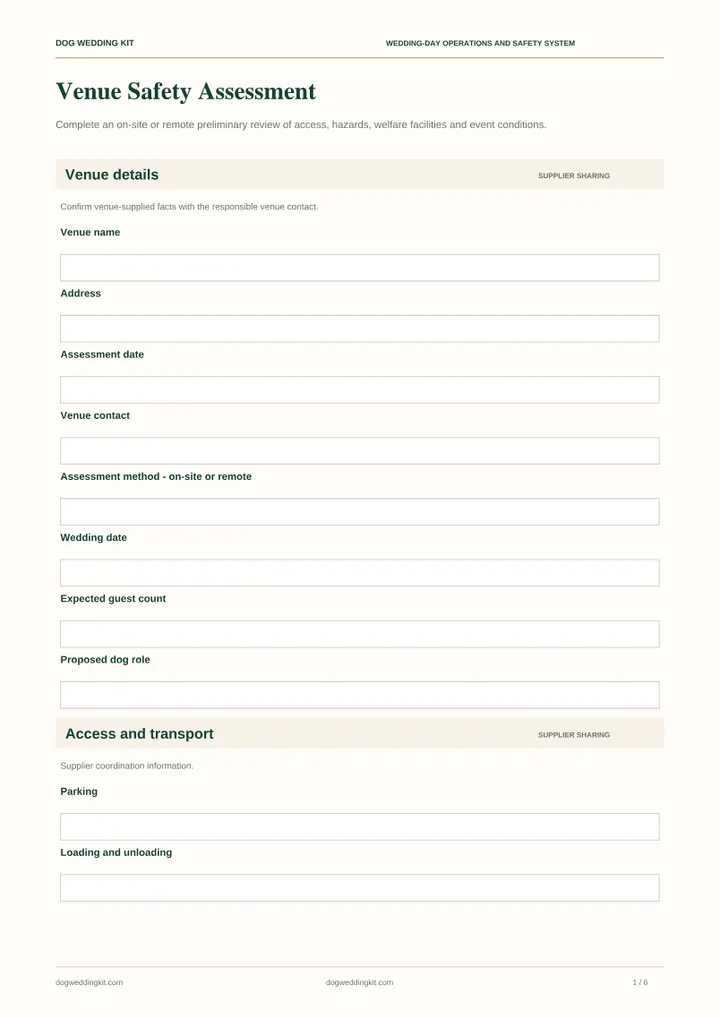
The chaperone may confirm dog-permitted areas, access routes, parking, a rest space, portrait locations, arrival and departure timing, and emergency access with the venue manager or planner. They may also coordinate directly with the photographer, videographer and ceremony coordinator. Read the partnership guide for the deeper process of working with venues and planners professionally.
Catering and security staff need only the details relevant to their work, such as keeping a service route clear or knowing where the dog may be. The chaperone should not create a parallel wedding plan; they translate the dog’s plan into the existing one.
12 · More than one dog
Handling multiple dogs
Adding a second dog changes more than the number of leads. The provider has to consider the dogs’ relationship and individual responses, vehicle setup, loading, equipment, safe holding points, ceremony positions, photography and what happens if one dog needs to leave.
Some pairs are best supported by two handlers; others need separate travel or shorter roles. There is no responsible unlimited ratio. Staffing and package scope should follow a case-specific assessment.
13 · Routine care
What about feeding and medication?
Routine feeding should follow written owner instructions: the right food, amount, time and known restrictions. Treats used for handling or photographs also need approval, particularly where allergies or medical diets are involved.
Medication is a separate boundary. If a provider offers it, the task must be within their competence, insurance and local rules, with precise owner and veterinary instructions where appropriate. Complex treatment and clinical decisions belong with veterinary professionals; a wedding booking does not expand a handler’s qualifications.
14 · Contingencies
What happens if the dog becomes overwhelmed?
The immediate response is to reduce pressure: leave the busy area, create distance, offer a quiet rest and water, and allow the dog time to recover. The chaperone then follows the agreed contact plan and decides whether a shorter appearance is still appropriate.
If the dog cannot settle, leaving the venue can be the right action. A ceremony cue, guest expectation or photograph is never a reason to force participation. Urgent health concerns require prompt veterinary attention under the emergency plan.
15 · Departure
What happens after the dog’s wedding role is finished?
The chaperone may take the dog home, hand over to a sitter or agreed family member, provide evening care, or begin a separately booked overnight service. The plan should name the address, authorised person, access method, food or medication due, and what to do if the recipient is unavailable.
A concise owner update can confirm that the dog has left, settled or been handed over. Responsibility ends at the point defined in the booking—not simply when the final photograph is taken.
16 · Extended care
Overnight dog wedding care
An overnight option may cover the evening meal and routine, toilet breaks, sleep arrangements, morning care and a final handover. It can be useful when the couple is staying at a venue or leaving immediately after the celebration.
It is not a default extension for every chaperone. Boarding or home-care arrangements can introduce different facilities, staffing, insurance and licensing requirements. The provider must be equipped and permitted to deliver exactly what is promised.
17 · Boundaries
What doesn’t a dog wedding chaperone normally replace?
The role is specialist dog care and dog-related logistics within an agreed service. It does not automatically replace a veterinarian, qualified behaviour professional, groomer, wedding planner, venue coordinator, photographer or legal adviser.
Those professionals may collaborate around the same dog or event. Clear boundaries help everyone: the chaperone follows veterinary or behavioural instructions rather than inventing them, works within the wedding timeline rather than controlling it, and supports photographs rather than directing the shoot.
18 · Role comparison
Dog wedding chaperone vs pet sitter, planner and venue staff
Job titles overlap, and an experienced pet sitter can add wedding chaperoning to their services. This comparison describes the usual centre of responsibility, not a rule about what any individual professional may offer.
| Area | Dog chaperone | Pet sitter | Wedding planner | Venue staff |
|---|---|---|---|---|
| Dog supervision | Core wedding-day role | Core pet-care role | Not usually | Not usually |
| Wedding logistics | Dog-related timings | Only if agreed | Whole-event coordination | Venue operations |
| Dog transport | Often available | May be available | Not usually | Not usually |
| Photography support | Dog positioning and care | Only if agreed | Schedule coordination | Location access |
| Routine pet care | During booked coverage | Core role | Not usually | Not usually |
| Overall wedding plan | No | No | Core role | Venue-specific only |
| Venue responsibility | Follow rules | Follow rules | Coordinate with venue | Core venue role |
19 · Packages
What can a typical package include?
Ceremony support
Arrival, settling, one ceremony role, comfort break and agreed handover.
Ceremony + portraits
Preparation, ceremony handling and a planned photography window.
Half-day care
Collection or arrival, selected wedding moments, breaks and departure.
Full wedding day
Longer coverage with structured care, participation and return arrangements.
Overnight extension
Separate evening, overnight and morning care where appropriately offered.
Multi-dog support
Additional planning, transport and staffing suited to the dogs and roles.
Names and inclusions vary by provider. Couples should compare the actual hours, journeys, meetings, care tasks, dog numbers and contingency terms rather than package labels alone. Providers can use the detailed pricing and packages guide to calculate how that scope affects cost, or compare the available Dog Wedding Kit options on the pricing page.
20 · Client information
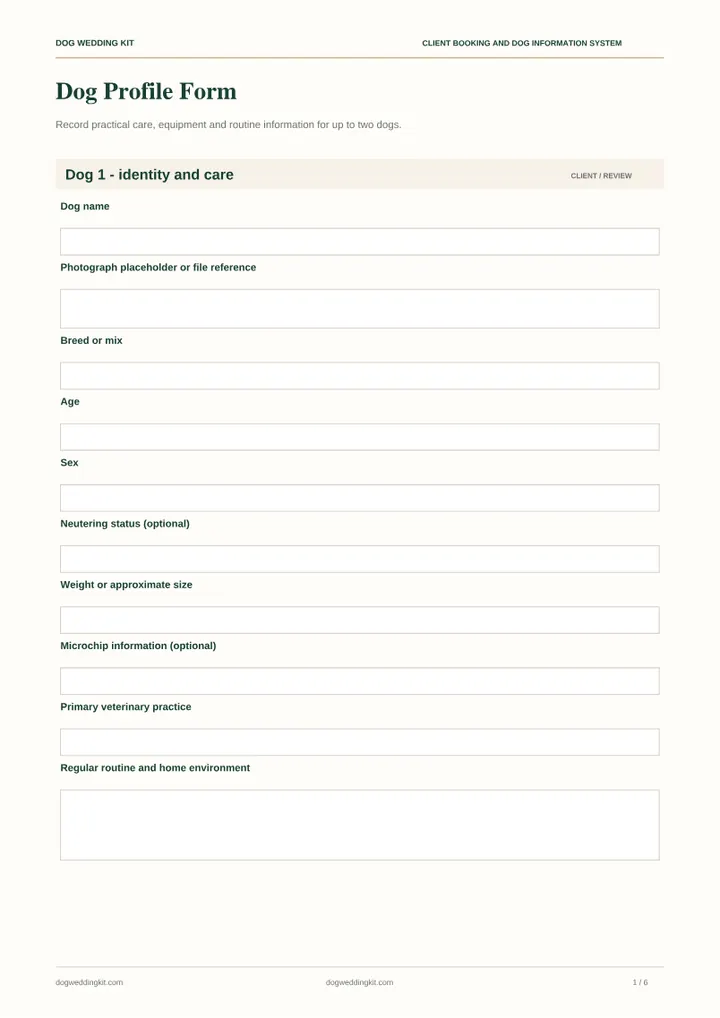
What information does a chaperone need from the couple?
- Dog profile, normal routine and handling cues
- Behaviour information and known triggers
- Health, veterinary and emergency details
- Food, treats and medication instructions
- Collar, harness, lead and other approved equipment
- Venue contact, rules, access and quiet-area details
- Planner, photographer and relevant supplier contacts
- Ceremony role and photography priorities
- Collection, return and authorised handover instructions
- Property access and security information where relevant
The provider should collect only what they genuinely need, explain how it will be used and keep it appropriately. A structured form reduces omissions but does not replace a conversation about unusual or changing needs.
21 · Professional fit
Who should consider offering this service professionally?
Experienced dog walkers, pet sitters, trainers, groomers, boarding or day-care professionals and established pet-care businesses may have a useful foundation. The strongest fit is someone with real handling competence, calm communication, dependable transport and the discipline to work to a live event schedule.
Wedding experience can be learned, but it should be built on sound dog-care judgement. The provider must also understand their service limits and the local requirements connected to transport, animal care, boarding, insurance and business activity. For the business-building process, read How to Start a Dog Wedding Chaperone Business.
22 · Operating systems
What systems make the service easier to run?
Reliable delivery depends on consistent information and decisions. Enquiry forms, dog profiles, venue information, suitability assessments, package builders, a pricing calculator, run sheets, timelines, safety plans and handover documents each give one part of the booking a clear home. See the forms and paperwork guide for the complete client-to-handover document workflow.
Partnership materials can then explain the same service to planners, venues and photographers. The Dog Wedding Kit organises those elements into an editable business and operations system; it does not replace handling experience, insurance, local compliance or professional advice.
For pet-care professionals
Build the service behind the wedding-day experience
Explore the client, dog, operations, safety, services, pricing and partnership resources included in the Complete Dog Wedding Chaperone Business Kit.
23 · Choosing well
What should couples look for when choosing a chaperone?
Look for relevant dog-care experience, a clearly described scope, appropriate insurance for the activities offered, and a welfare approach that allows the plan to change. The provider should ask detailed questions, explain transport and handover, coordinate professionally, and show what happens if the dog or schedule cannot follow the original plan.
- A calm, dog-specific information process
- Transparent inclusions, exclusions, travel and pricing
- Realistic staffing for the number of dogs
- A weather, delay and early-departure plan
- Clear professional boundaries and referral to specialists
- Written booking, cancellation and handover arrangements
No invented badge or universal certification proves suitability everywhere. Ask questions that match the actual booking, check references or reviews where available, and choose someone whose answers are specific rather than reassuring but vague. For support about Dog Wedding Kit itself, use the public contact form, or see the broader product FAQ.
The role in one sentence
One professional cares for the dog and connects their needs to the wedding plan.
The details can change from a short portrait visit to a full day with transport and handover. What should not change is clear responsibility, calm coordination and a willingness to put the dog’s welfare ahead of the schedule.
Common questions
Dog wedding chaperone FAQ
Is a dog wedding chaperone the same as a pet sitter?
The roles overlap in hands-on pet care, but a wedding chaperone’s agreed work normally includes wedding timings, venue movement and coordination around ceremony or photography moments. Some experienced pet sitters also offer this specialist service.
How long does a dog wedding chaperone stay?
It depends on the package and the dog’s plan. Coverage might be a short ceremony and portrait window, a half day, a full day or an overnight extension. The booked hours and what happens if the schedule runs late should be clear in advance.
Can a chaperone transport the dog?
Many providers offer collection and return transport, while others begin at the venue. Ask how the dog is secured, what vehicle and insurance arrangements apply, and which journeys are included.
Can the chaperone take the dog home after photographs?
Yes, when that return journey and home-access or handover plan are part of the booking. The couple should confirm who receives the dog, any property-access instructions and what update they expect.
Can one chaperone care for multiple dogs?
Sometimes, but safe staffing depends on the dogs, transport, environment and planned roles. A responsible provider may require another handler, separate travel or a simpler participation plan.
Does the chaperone stay for the reception?
Only if reception coverage is included. A dog may attend a controlled greeting period and then leave, or remain for longer care where the venue, dog and package make that suitable.
Can they provide overnight care?
Some do. Overnight care should be a clearly defined service offered only with suitable experience, insurance, facilities and any locally required permissions.
What happens if the dog becomes stressed?
The chaperone should follow the agreed contingency plan, move to a quiet place, offer an appropriate break and shorten or end participation if needed. A photograph or ceremony role should never take priority over the dog’s welfare.
Research and welfare notes
This guide was informed by current service patterns published by dog wedding chaperone and wedding pet attendant providers in the UK, US and Australia, then checked against independent welfare and official guidance. Service examples describe possibilities, not universal inclusions.
- RSPCA: understanding dog behaviour and body language
- PDSA: heatstroke in dogs and hot-weather and vehicle safety
- American Kennel Club: planning a dog’s wedding participation
- GOV.UK: animal transport guidance (a jurisdiction-specific example)
- Service-pattern review: The Bed and Bone, The Bark Park, Always and Furever, PawCasion and US wedding pet attendant listings on The Knot.
Last reviewed 15 August 2026. This article is general information, not veterinary, behaviour, legal or insurance advice. Read more about Dog Wedding Kit’s scope and editorial approach.